
12 Critical Challenges in Healthcare Marketing Explained Now
The challenges in healthcare marketing have become more complex as patients increasingly use websites, search engines, online reviews, and social media to make healthcare decisions. Doctors, clinics, hospitals, and diagnostic centres in Kerala must communicate clearly while protecting patient trust, following ethical standards, and presenting medically accurate information.
Unlike ordinary business promotion, healthcare communication deals with personal concerns, medical decisions, privacy, and professional responsibility. A campaign cannot focus only on clicks, traffic, or visibility. It must also provide useful information, avoid misleading promises, and guide patients towards appropriate care.
Understanding the challenges in healthcare marketing helps healthcare organisations identify weak areas, improve communication, and build a more reliable digital presence.
What Are the Challenges in Healthcare Marketing?
The challenges in healthcare marketing are the difficulties healthcare organisations face while promoting services, educating patients, managing their reputation, and generating appointment enquiries.
These difficulties may appear in:
- Search engine optimisation
- Medical content creation
- Social media communication
- Website management
- Paid advertising
- Online reputation management
- Patient engagement
- Data protection
- Brand development
- Performance measurement
Some problems are caused by weak planning, while others result from industry regulations, changing patient behaviour, technical limitations, or strong competition.
The challenges in healthcare marketing are interconnected. For example, an outdated website may reduce patient trust, weaken search rankings, increase advertising costs, and lower enquiry rates at the same time.
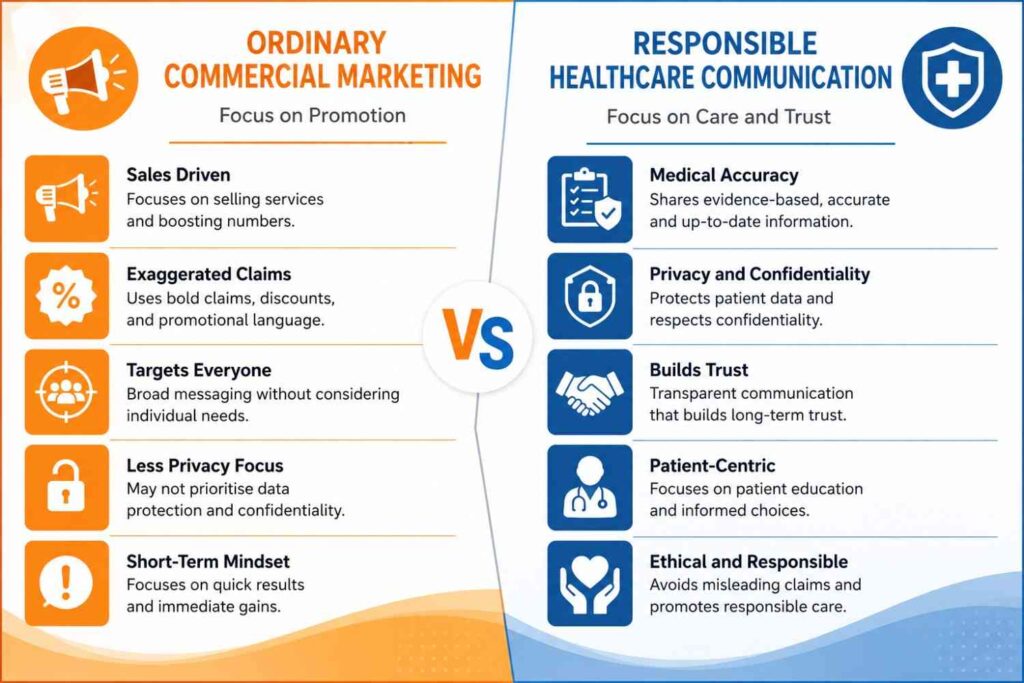
Why Healthcare Marketing Is More Difficult Than General Marketing
Healthcare services cannot be promoted in the same way as clothing, electronics, or entertainment products. A patient may be anxious, confused, or searching for help with a sensitive concern.
Healthcare marketers must balance visibility with responsibility. Content should be engaging but not sensational. Advertisements should attract attention but must not create fear or make unrealistic claims.
The main differences include:
- Medical information must be accurate.
- Patient privacy must be protected.
- Treatment outcomes cannot be guaranteed.
- Content should not encourage self-diagnosis.
- Professional credibility must be maintained.
- Sensitive topics require careful wording.
- Ethical and advertising rules must be followed.
These responsibilities make the challenges in healthcare marketing more demanding than those found in many other sectors.
Main Causes of Challenges in Healthcare Marketing
Several internal and external factors contribute to marketing difficulties.
Lack of a Clear Strategy
Many organisations begin posting on social media or running advertisements without defining their target audience, services, objectives, or measurement methods.
Without a strategy, activities become disconnected. The website may target one audience while social media content speaks to another. This inconsistency is one of the common challenges in healthcare marketing.
Limited Patient Understanding
Healthcare professionals understand medical terminology, but patients may not. When content is too technical, visitors may leave without understanding the service.
Patient-friendly communication should explain medical topics accurately using simple language.
Rapid Changes in Digital Platforms
Search engines, social platforms, advertising systems, and privacy rules continue to change. A method that worked previously may become less effective.
Healthcare organisations must regularly review their digital strategy rather than relying on the same approach for several years.
Strong Local Competition
Patients often compare several nearby providers before booking an appointment. Search rankings, reviews, website quality, location information, and response speed can influence their decision.
Competition is therefore one of the major challenges in healthcare marketing, especially for frequently searched services.
Insufficient Marketing Resources
Smaller clinics may not have dedicated writers, designers, SEO professionals, advertising specialists, or website developers.
As a result, marketing tasks may be handled irregularly or assigned to staff members who already have clinical responsibilities.
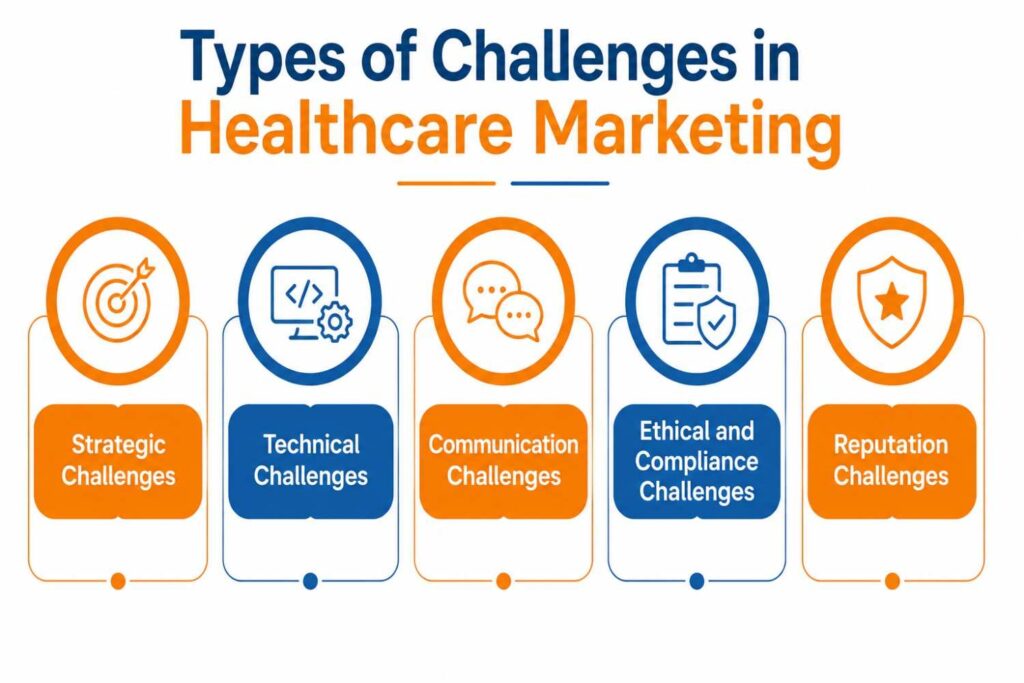
Types of Challenges in Healthcare Marketing
The challenges in healthcare marketing can be grouped into several categories. Understanding each category makes it easier to choose suitable solutions.
Strategic Challenges
Strategic problems occur when an organisation has no clear marketing direction.
Examples include:
- Unclear growth objectives
- Poor audience targeting
- Inconsistent brand messaging
- No content calendar
- Weak competitor analysis
- Lack of defined performance indicators
Technical Challenges
Technical issues affect the visibility and usability of digital platforms.
These may include:
- Slow website speed
- Poor mobile performance
- Broken pages or links
- Missing security features
- Incorrect tracking setup
- Weak website structure
- Duplicate content
- Search indexing problems
Communication Challenges
Communication problems arise when information is unclear, overly technical, incomplete, or inconsistent.
These challenges in healthcare marketing may prevent patients from understanding symptoms, services, appointment procedures, or treatment options.
Ethical and Compliance Challenges
Healthcare campaigns must avoid exaggerated claims, guaranteed outcomes, misleading comparisons, and inappropriate use of patient information.
Ethical review is necessary before publishing medical advertisements, patient stories, treatment images, or outcome-based content.
Reputation Challenges
Online reviews, comments, complaints, and inaccurate public information can affect patient confidence.
Reputation management requires timely monitoring, professional responses, and a consistent process for correcting inaccurate details.
12 Critical Challenges in Healthcare Marketing
1. Building and Maintaining Patient Trust
Trust is central to every healthcare decision. Patients want to know whether the provider is qualified, approachable, transparent, and experienced in the relevant area.
A poorly designed website, unclear claims, unanswered reviews, or inconsistent information can reduce confidence.
To address this challenge:
- Publish accurate educational content.
- Display professional qualifications clearly.
- Maintain consistent contact information.
- Explain services without exaggerated promises.
- Respond professionally to public feedback.
- Keep websites and profiles updated.
Trust cannot be created through a single campaign. It develops through consistent and responsible communication.
2. Communicating Complex Medical Information
Medical subjects are often difficult to explain. Simplifying them too much may create inaccuracies, while using too much technical language may confuse patients.
This is one of the most persistent challenges in healthcare marketing.
Effective medical content should:
- Define unfamiliar terms.
- Use short sentences.
- Explain one idea at a time.
- Separate general information from medical advice.
- Encourage professional assessment when appropriate.
- Avoid creating unnecessary fear.
Content should educate patients without encouraging them to diagnose or treat themselves.
3. Following Ethical Advertising Standards
Healthcare advertising requires careful review because inappropriate claims may mislead vulnerable audiences.
Risky language may include:
- Guaranteed results
- Permanent cures
- Completely risk-free procedures
- Claims of being the undisputed best
- Fear-based warnings
- Unsupported comparisons
- Unrealistic before-and-after promises
Ethical marketing focuses on education, accessibility, professional expertise, and informed decision-making.
4. Protecting Patient Privacy
Patient information must be handled responsibly. Photographs, videos, testimonials, case details, and medical histories should not be published casually.
Privacy-related challenges in healthcare marketing may arise when:
- Consent procedures are unclear.
- Staff share patient information informally.
- Contact forms collect unnecessary data.
- Third-party tools are poorly managed.
- Patient stories contain identifiable details.
- Images are used without documented permission.
Healthcare organisations need clear approval processes for every form of patient-related content.
5. Creating Consistent, High-Quality Content
Publishing one article or a few social posts is not enough to build sustained visibility.
Consistent content production can be difficult because each topic may require research, medical review, writing, design, optimisation, and approval.
A practical content system can include:
- Monthly topic planning
- Service-page updates
- Frequently asked question content
- Patient education articles
- Short educational videos
- Google Business Profile posts
- Social media awareness posts
- Seasonal health information
Quality should take priority over publishing frequency.
6. Ranking in Competitive Search Results
Search engine competition is one of the largest challenges in healthcare marketing. Large hospitals, directories, established clinics, and informational websites may compete for the same keywords.
Ranking improvement may require:
- Proper keyword mapping
- Useful service pages
- Local search optimisation
- Technical SEO
- Internal linking
- Original medical content
- Accurate business listings
- Mobile-friendly design
- Relevant backlinks
- Regular performance review
Search visibility normally improves through continued optimisation rather than isolated changes.
7. Managing Online Reviews and Reputation
Reviews influence how potential patients perceive a healthcare organisation. However, healthcare providers must respond without revealing private information or discussing individual medical details publicly.
A suitable review-management process should include:
- Monitoring major platforms
- Responding politely
- Avoiding arguments
- Acknowledging concerns
- Moving sensitive discussions offline
- Correcting inaccurate profile information
- Reporting inappropriate or fraudulent reviews when necessary
Ignoring every review can make a profile appear inactive, while defensive responses may damage trust.
8. Reaching the Right Audience
High website traffic does not always produce suitable enquiries. A clinic may attract visitors from irrelevant locations or people searching for services it does not provide.
Audience targeting is one of the strategic challenges in healthcare marketing.
Better targeting involves understanding:
- Patient age groups
- Service requirements
- Search language
- Relevant locations
- Common concerns
- Preferred communication channels
- Appointment intent
- Device usage
- Information needs
Content and advertising should be matched to the actual services available.
9. Improving Website Experience
A website may receive traffic but fail to convert visitors because important information is difficult to find.
Common website problems include:
- Slow loading
- Small text
- Confusing navigation
- Missing doctor profiles
- Incomplete service pages
- Hidden contact details
- Complicated enquiry forms
- Poor mobile layout
- Outdated clinic timings
- Too many distracting pop-ups
A healthcare website should help visitors understand the service and take the next appropriate step without confusion.
10. Measuring Real Marketing Performance
Likes, impressions, and page views may look positive, but they do not always reflect meaningful growth.
Measurement is among the most misunderstood challenges in healthcare marketing.
Useful indicators may include:
- Qualified appointment enquiries
- Calls from relevant searches
- Contact-form submissions
- Direction requests
- Search ranking growth
- Organic traffic to service pages
- Advertising conversion rates
- Cost per qualified enquiry
- Returning website visitors
- Engagement with educational content
Reports should connect marketing activity with practical goals rather than presenting isolated numbers.
11. Coordinating Different Marketing Channels
SEO, social media, content, paid advertising, website development, local search, branding, and reputation management should support one another.
Problems develop when different teams work without coordination. A paid advertisement may lead to an outdated page, or a social post may use information that conflicts with the website.
A shared strategy, brand guide, content calendar, and approval process can reduce these challenges in healthcare marketing.
12. Keeping Information Accurate and Updated
Doctor availability, clinic timings, phone numbers, service details, locations, and appointment procedures may change.
Outdated information can lead to missed appointments, frustrated patients, and reduced trust.
Healthcare organisations should regularly audit:
- Website contact pages
- Google Business Profile details
- Social media biographies
- Online directories
- Doctor profiles
- Service descriptions
- Appointment links
- Frequently asked questions
- Advertising landing pages
Accuracy is both a marketing responsibility and an important part of patient communication.
Tips for Overcoming Challenges in Healthcare Marketing
Use these practical tips to improve performance:
- Focus on patient questions rather than promotional slogans.
- Use simple language without removing medical accuracy.
- Keep every online profile updated.
- Create a separate page for each major service.
- Avoid copying content from competitors.
- Review advertisements before publishing.
- Track calls, forms, and appointment actions.
- Respond to reviews professionally.
- Optimise the website for mobile users.
- Maintain consistent colours, tone, and information.
- Review old content regularly.
- Use data to guide future decisions.
- Coordinate SEO, social media, and advertising activities.
- Avoid unrealistic treatment claims.
- Make contact and appointment information easy to find.
These practices do not remove every difficulty immediately, but they create a stronger system for managing the challenges in healthcare marketing.
Conclusion
The challenges in healthcare marketing involve much more than producing advertisements or posting regularly on social media. Healthcare organisations must communicate accurately, protect privacy, build trust, improve digital usability, maintain ethical standards, and measure outcomes that genuinely support patient access.
A coordinated strategy can turn these difficulties into opportunities for stronger communication and sustainable visibility. By auditing current platforms, correcting weak areas, publishing useful content, and reviewing performance consistently, doctors, clinics, hospitals, and healthcare organisations in Kerala can address the challenges in healthcare marketing responsibly and effectively.
To learn more about improving your website’s visibility on Google, visit Google SEO Starter Guide.

