
How Google Reviews Influence Patient Decisions
When patients search for a doctor, clinic, hospital, or healthcare service online, they often look beyond the website. In Kerala, Google reviews can become an important part of that decision-making process. Patients may compare ratings, read experiences shared by others, check how a healthcare provider responds to feedback, and look for signs of professionalism before making an appointment.
This is why understanding how Google reviews influence patient decisions is increasingly important for healthcare providers. Reviews do not replace medical expertise or personal consultation, but they can shape a patient’s first impression of a healthcare practice.
A strong review profile can provide social proof, improve confidence, support local visibility, and encourage potential patients to learn more about a provider. At the same time, a small number of reviews, unanswered feedback, or repeated concerns may cause prospective patients to look elsewhere.
Why Google Reviews Matter in Healthcare
Healthcare decisions are often more personal than ordinary purchasing decisions. Patients want to feel comfortable with the doctor, clinic, or hospital they choose.
Before contacting a provider, a person may look at:
- Google star ratings
- Number of reviews
- Recent reviews
- Patient experiences
- Responses from the healthcare provider
- Clinic information
- Photographs
- Services
- Website content
- Location and contact details
This explains why how Google reviews influence patient decisions has become an important topic in healthcare digital marketing and healthcare marketing agency.
Reviews provide a form of social proof. They show potential patients that other people have interacted with the healthcare provider.
However, reviews should be viewed as one part of the overall decision-making process rather than the only factor.
How Google Reviews Influence Patient Decisions
Google reviews can affect patients at several stages of their online journey. They may influence whether someone clicks on a business profile, visits the website, calls the clinic, or continues researching another provider.
1. Reviews Create an Initial Impression
- A Google Business Profile is often one of the first results patients see when searching for a healthcare provider.
- The star rating and visible reviews can immediately create an impression.
- For example, a profile with several recent and detailed reviews may appear more established than a profile with very little feedback.
- This does not mean that patients automatically choose the provider with the highest rating. They may also consider the quality, relevance, and recency of the reviews.
2. Reviews Provide Social Proof
People naturally look for evidence when making important decisions.Patient reviews provide social proof by showing that other people have interacted with a healthcare provider.
Reviews may discuss experiences related to:
- Appointment processes
- Communication
- Staff interaction
- Clinic environment
- Waiting experience
- General service experience
- Professional communication
Such information can help potential patients understand what to expect.
3. Reviews Can Build Trust
Trust is particularly important in healthcare.Patients may be more comfortable contacting a provider when they see consistent, authentic feedback from other patients.
Positive reviews can support a professional online reputation, especially when they contain specific and genuine experiences rather than very short statements.
However, trust is also affected by how the healthcare provider communicates across its website, Google profile, social media channels, and other platforms.
4. Reviews Can Reduce Uncertainty
Choosing a healthcare provider can involve uncertainty.
A patient may wonder:
- Is the clinic professional?
- Is communication clear?
- Is the appointment process convenient?
- Do other patients describe positive experiences?
- Does the provider respond to feedback?
- Is the information online accurate?
Reviews can help answer some of these questions.
This is another reason how Google reviews influence patient decisions deserves attention from healthcare businesses developing a digital marketing strategy.
5. Reviews Can Encourage Website Visits and Enquiries
A strong online reputation may encourage potential patients to explore a healthcare provider further.
After reading reviews, a patient may:
- Visit the website.
- Read about the doctor.
- Explore available services.
- Check appointment information.
- Call the clinic.
- Submit an enquiry.
Reviews therefore can contribute to the broader patient journey.
They do not directly guarantee appointments, but they may help move a potential patient from awareness to consideration.
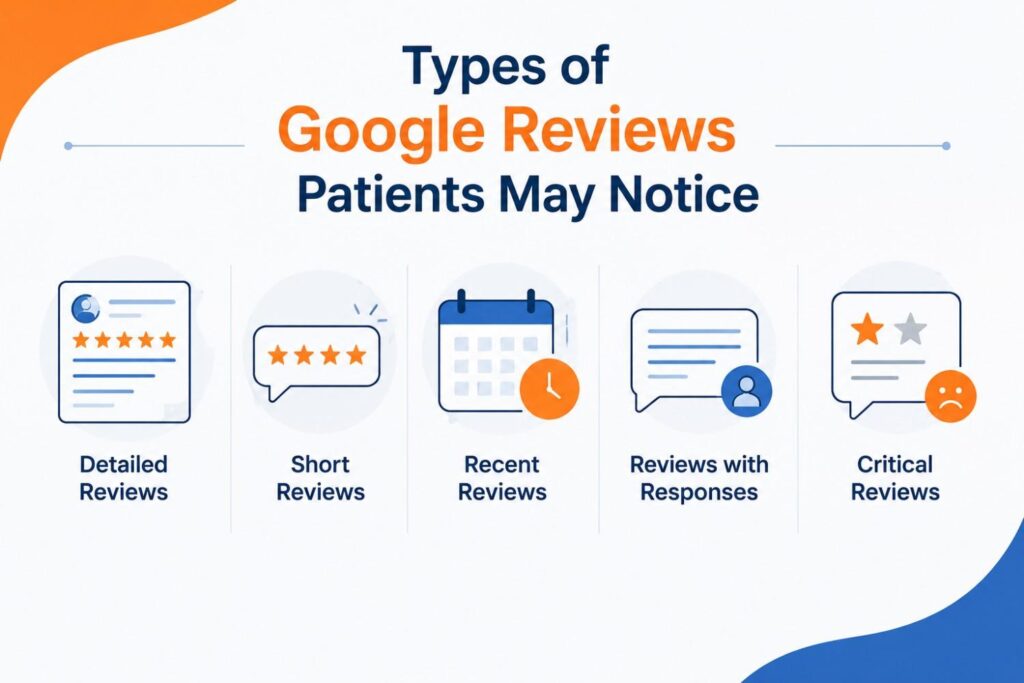
Types of Google Reviews Patients May Notice
Not every review has the same influence.
- Detailed Reviews
Detailed reviews may provide more context than a simple rating.
They can describe aspects of the patient’s experience and give prospective patients more information to consider.
- Short Reviews
Short reviews can still contribute to the overall review profile, particularly when they are part of a larger collection of genuine feedback.
- Recent Reviews
Recent feedback may appear more relevant to patients because healthcare services, staff, facilities, and processes can change over time.
- Reviews With Responses
A professional response can show that the healthcare provider pays attention to patient feedback.
- Critical Reviews
Negative or critical reviews may receive particular attention from prospective patients. The way a provider responds can influence how readers interpret the situation.
How Google Reviews Influence Patient Decisions Through Trust
Trust is one of the strongest connections between online reputation and patient decision-making.
A healthcare provider can have an excellent website, but potential patients may still search for independent experiences before making contact.
Google reviews can act as an additional source of information.
Patients may look for patterns rather than relying on a single review.
For example, they may consider:
- Whether feedback is consistent
- Whether reviews are recent
- Whether reviews provide specific details
- How the business responds
- Whether concerns appear repeatedly
- Whether the overall profile looks authentic
This means healthcare providers should focus on building genuine patient experiences rather than simply trying to increase the number of reviews.
The Role of Review Recency
- Review recency is another factor worth considering.
- A healthcare provider may have many reviews from several years ago, but potential patients may still want to know about more recent experiences.
- Regular genuine feedback can help keep a Google Business Profile active and informative.
- However, healthcare providers should never encourage misleading or fabricated reviews simply to make a profile look active.
- The focus should remain on providing good service and making it easy for genuine patients to share their voluntary feedback.
The Importance of Review Quality
The number of reviews is not the only consideration.A profile with many vague reviews may provide less useful information than a profile containing authentic, detailed feedback.High-quality reviews can help prospective patients understand the overall patient experience.
Useful feedback may naturally mention areas such as:
- Communication
- Professionalism
- Appointment experience
- Staff interaction
- Clinic environment
- General service experience
Healthcare providers should avoid asking patients to include sensitive medical information in public reviews.
Patient privacy should always be respected.
How Healthcare Providers Should Respond to Reviews
Review management is not simply about collecting feedback.
Responding appropriately can also influence the way prospective patients perceive a healthcare provider.
- Respond to Positive Reviews
A simple professional response can acknowledge the patient’s feedback and show appreciation.
The response does not need to be lengthy.
- Respond to Critical Reviews Professionally
A critical review should not be answered defensively.
Instead, the provider can:
- Acknowledge the feedback
- Maintain a respectful tone
- Avoid discussing confidential medical details
- Avoid revealing patient information
- Invite the person to contact the practice privately when appropriate
Public responses should protect patient confidentiality.
- Avoid Arguments
A public disagreement can create a negative impression even when the healthcare provider believes the review is unfair.
Professional communication is generally more appropriate than an emotional response.
- Google Reviews and Local SEO
Reviews can also form part of local search visibility.
Google Business Profile is an important component of local digital presence for healthcare practices.
A properly managed profile can include:
- Accurate business information
- Correct categories
- Services
- Photographs
- Website details
- Appointment information
- Reviews
- Business updates
When considering how Google reviews influence patient decisions, it is useful to understand that reviews exist within this broader local search ecosystem.
Patients may discover a provider through Google Search or Maps and then use the review profile to decide whether to investigate further.
Benefits of Maintaining a Strong Review Profile
A healthy and authentic review profile can support several aspects of healthcare marketing.
- Improved Credibility
Consistent genuine feedback can strengthen the credibility of a healthcare provider’s online presence.
- Better Patient Confidence
Reviews may reduce uncertainty for people who are researching a provider for the first time.
- Stronger Online Reputation
Regular feedback gives healthcare businesses an opportunity to demonstrate their commitment to patient experience.
- More Informative Search Profiles
Reviews can add context to the information already displayed on a Google Business Profile.
- Better Patient Engagement
Responding to feedback creates another communication point between the practice and its audience.
- Support for Local Discovery
Reviews can contribute to the overall local search presence of a healthcare business.
Common Review Management Problems
Understanding how Google reviews influence patient decisions also requires understanding what can weaken a review profile.
Common problems include:
- Very few reviews
- Outdated reviews
- Unanswered feedback
- Repeated complaints
- Unprofessional responses
- Inconsistent patient experiences
- Requests for inappropriate review content
- Sharing confidential patient information
- Fake or manipulated reviews
These problems can affect how prospective patients perceive the healthcare provider.
What Healthcare Providers Should Avoid
A strong reputation strategy requires ethical practices.
Avoid:
- Buying reviews
- Creating fake reviews
- Asking employees to pose as patients
- Writing reviews on behalf of patients
- Pressuring patients to leave positive feedback
- Offering rewards specifically for positive reviews
- Posting confidential patient information
- Arguing publicly with reviewers
- Making medical claims in review responses
Authenticity is more valuable than an artificially high review count.
Google Reviews Compared With Other Trust Signals
Google reviews are important, but they are not the only factor patients consider.
A healthcare provider’s digital reputation may also include:
- Professional website
- Doctor credentials
- Educational content
- Service information
- Social media presence
- Clinic photographs
- Local search information
- Patient communication
- Professional branding
This means healthcare providers should not build their entire marketing strategy around reviews alone.
A strong digital presence combines several trust signals.

Conclusion
Understanding how Google reviews influence patient decisions can help healthcare providers approach online reputation management more strategically. Reviews can create an initial impression, provide social proof, reduce uncertainty, support trust, and encourage potential patients to explore a healthcare provider further.
However, reviews should never be treated as a replacement for professional qualifications, appropriate medical care, or reliable healthcare information. They are one part of a larger patient decision-making journey.
Healthcare providers can strengthen their online reputation by delivering consistent patient experiences, encouraging genuine feedback, responding professionally, protecting patient privacy, and maintaining an accurate Google Business Profile.
For healthcare providers in Kerala, combining authentic Google reviews with healthcare SEO, useful content, local search optimization, and a professional website can create a stronger digital presence and help potential patients make more informed decisions.
To learn more about improving your website’s visibility on Google, visit Google SEO Starter Guide.

