
How Doctor Branding Builds Patient Trust
Trust is an important part of every healthcare relationship. Before choosing a doctor, patients often want to know more than a name and qualification. They may look for information about professional experience, specialty, communication style, educational content, and online presence.
This is where how doctor branding builds patient trust becomes an important topic.
Doctor branding is not simply about creating a logo, posting photographs, or maintaining social media accounts. It is the process of presenting a doctor’s genuine professional identity consistently across relevant digital and offline channels.
When patients can easily find accurate information about a doctor, understand their area of expertise, and access useful educational content, the overall professional experience can become clearer.
A thoughtful doctor branding strategy can therefore support trust by combining expertise, transparency, consistency, education, and responsible communication.
What Is Doctor Branding?
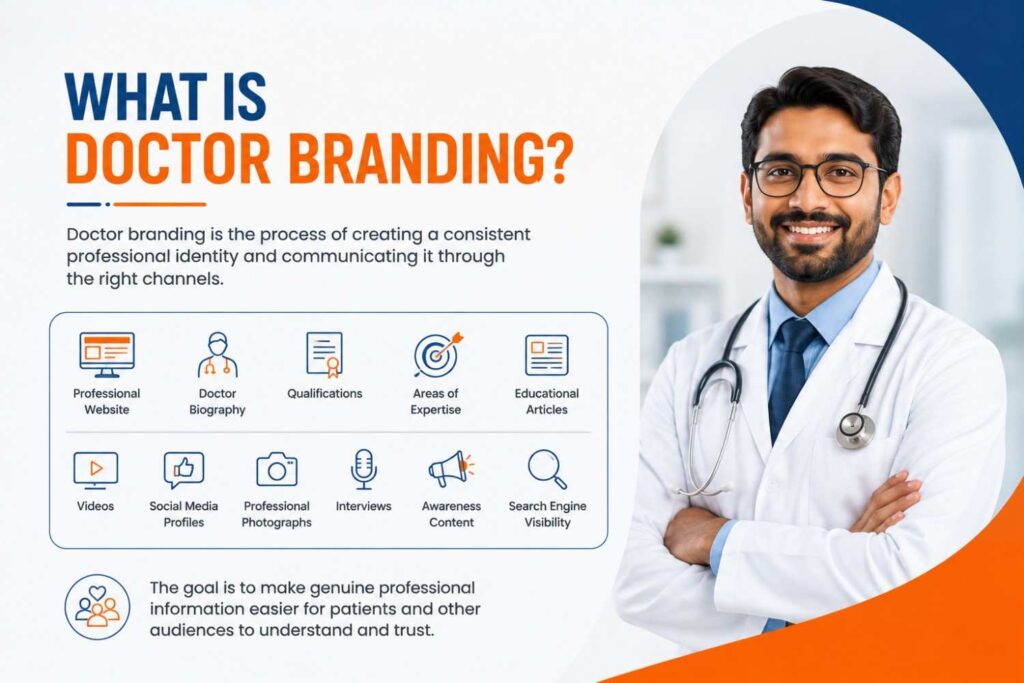
Doctor branding is the process of creating a consistent professional identity around a doctor and communicating that identity through appropriate channels.
It may include:
- Professional website
- Doctor biography
- Qualifications
- Areas of expertise
- Educational articles
- Videos
- Social media profiles
- Professional photographs
- Interviews
- Healthcare awareness content
- Search engine visibility
The purpose is not to create an artificial image.
Instead, doctor branding should make genuine professional information easier for patients and other audiences to understand.
A well-developed brand answers basic questions such as:
- Who is the doctor?
- What is the doctor’s specialty?
- What areas does the doctor focus on?
- What professional experience do they have?
- What type of information do they share?
- Where can people find reliable professional information?
Why Trust Matters in Healthcare
Healthcare decisions are often personal and important.
Patients may feel uncertain when they are looking for a specialist, considering a procedure, or trying to understand a medical concern.
Trust can help create a more comfortable starting point for communication.
However, trust cannot be created simply through attractive branding.
It develops through a combination of:
- Professional competence
- Clear communication
- Transparency
- Consistency
- Respect
- Reliable information
- Appropriate patient communication
Doctor branding can support these qualities by communicating them clearly through the doctor’s professional presence
How Doctor Branding Builds Patient Trust
- The question how doctor branding builds patient trust can be understood through the different experiences patients have before and during their healthcare journey.
- A patient may first discover a doctor through search results. They may then visit the doctor’s website, read an article, watch a video, check professional information, and finally contact the clinic.
- Every interaction contributes to their impression.
- If the information is accurate, consistent, useful, and professionally presented, the patient can develop a clearer understanding of the doctor.
- That is where branding becomes more than visual design.
- It becomes a communication system.
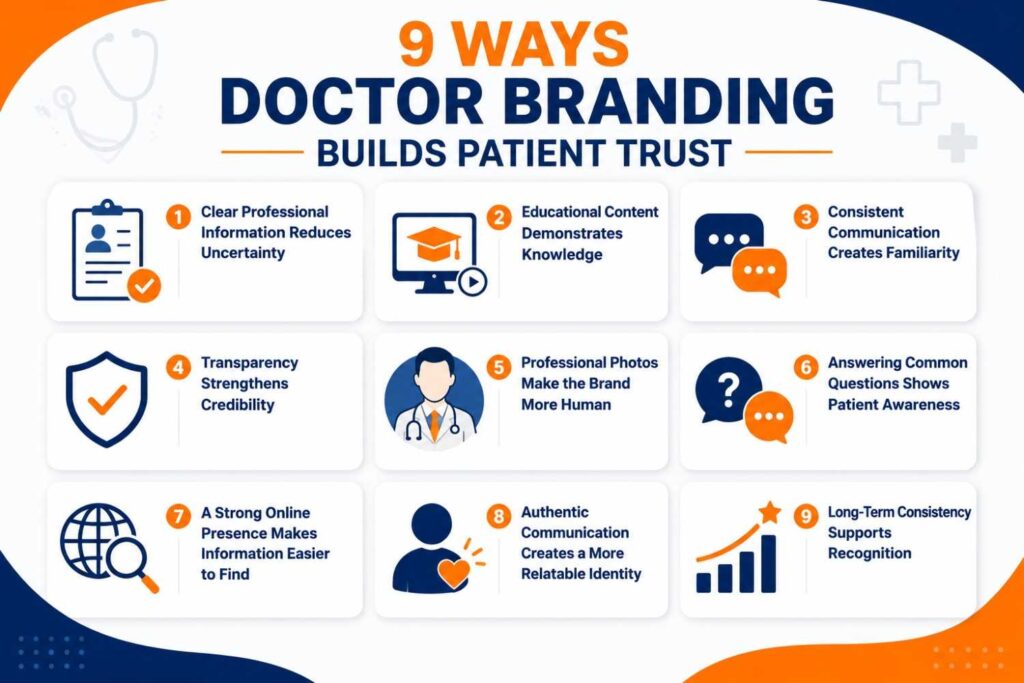
9 Ways Doctor Branding Builds Patient Trust
1. Clear Professional Information Reduces Uncertainty
Patients often have questions before contacting a doctor.
A professional online profile can provide information such as:
- Medical qualification
- Specialty
- Areas of expertise
- Professional experience
- Clinic details
- Consultation information
When essential information is easy to find, patients do not have to rely on incomplete sources.
Clear information can make the initial research process easier.
2. Educational Content Demonstrates Knowledge
One of the strongest ways how doctor branding builds patient trust can be seen is through educational content.
Doctors can explain medical topics using:
- Blog articles
- Short videos
- FAQs
- Infographics
- Interviews
- Awareness posts
For example, an orthopedic doctor could explain what patients should generally know about joint injuries.
A dermatologist could discuss common skin concerns and preventive care.
A cardiologist could explain general heart-health topics.
This type of content gives audiences an opportunity to understand the doctor’s communication and educational approach.
3. Consistent Communication Creates Familiarity
Imagine seeing a doctor’s name on a website, then finding a completely different specialty description on social media.
Inconsistent information can create confusion.
A strong doctor brand keeps important professional details consistent across platforms.
These may include:
- Doctor’s name
- Specialty
- Qualifications
- Professional photograph
- Areas of expertise
- Website information
Consistency creates familiarity.
When patients repeatedly encounter accurate and recognizable information, it becomes easier to identify the doctor across different digital channels.
4. Transparency Strengthens Credibility
Transparency is particularly important in healthcare communication.
Doctors can strengthen professional credibility by clearly presenting:
- Qualifications
- Professional experience
- Areas of specialization
- Relevant certifications
- Academic achievements
- Professional affiliations
Information should be presented accurately without exaggeration.
For example, a doctor’s biography should describe actual experience rather than relying on unsupported descriptions such as “the best” or “number one.”
5. Professional Photos Make the Brand More Human
A professional photograph can make an online profile feel more personal.
Patients may be more comfortable when they can associate a doctor’s name with a clear, professional identity.
A suitable doctor photograph should generally be:
- Professional
- Recent
- Clear
- Appropriate for healthcare
- Consistent across important platforms
Visual consistency can also help people recognize the doctor more easily.
6. Answering Common Questions Shows Patient Awareness
Patients frequently search for answers before contacting a healthcare professional.
Doctor branding can incorporate frequently asked questions into websites, blogs, and social media content.
Examples include:
- What happens during a consultation?
- What should I bring to an appointment?
- What does a particular procedure involve?
- When should someone consult a specialist?
- What questions should patients ask?
Answering these questions does not replace medical consultation.
Instead, it helps people understand healthcare information and prepare for professional discussions.
7. A Strong Online Presence Makes Information Easier to Find
Patients may use multiple digital channels when researching doctors.
These may include:
- Search engines
- Websites
- Social media
- Google Business Profiles
- Healthcare directories
- Video platforms
If important professional information is scattered or outdated, patients may struggle to understand the doctor’s background.
A coordinated digital presence makes relevant information easier to access.
8. Authentic Communication Creates a More Relatable Identity
Patients are not only looking for medical qualifications.
They may also appreciate doctors who explain topics clearly and communicate in a way that feels understandable.
Authentic communication can include:
- Simple explanations
- Conversational educational videos
- Professional opinions
- Healthcare awareness discussions
- Answers to common questions
The goal is not to create a scripted personality.
The doctor’s real professional communication style should remain at the center of the brand.
9. Long-Term Consistency Supports Recognition
Trust is rarely established from one post or one website visit.
It develops through repeated experiences.
A doctor who consistently provides useful information can create a recognizable professional presence over time.
For example, monthly educational articles combined with regular short videos and an updated professional profile can gradually build a larger library of useful information.
This long-term approach is one of the most important parts of understanding how doctor branding builds patient trust.
The Role of Educational Content
Healthcare content should primarily help people understand medical topics.
A doctor can develop content around questions frequently raised by patients.
Educational Blog Topics
Examples include:
- Understanding common medical conditions
- Treatment preparation
- Recovery information
- Preventive healthcare
- Common misconceptions
- Questions to discuss with a doctor
Video Topics
Short videos can address one question at a time.
A useful format is:
Question → Explanation → Important Consideration → Professional Guidance
This keeps the message focused.
FAQ Content
FAQ pages can provide quick answers to general questions while encouraging readers to seek individualized medical advice when appropriate.
Social Media and Patient Trust
Social media can support doctor branding when it is used primarily for useful and responsible communication.
Doctors can share:
- Healthcare education
- Short videos
- FAQs
- Awareness content
- Professional milestones
- Conference participation
- Research-related information
The platform should match the doctor’s communication goals.
For example, short educational videos may work well on video-focused platforms, while professional achievements and academic discussions may be more suitable for professional networking platforms.
The key is not to post everywhere.
The key is to communicate consistently where the intended audience is present.
The Importance of Consistency
Consistency is one of the foundations of professional branding.
Imagine a doctor has:
- One specialty listed on a website
- A different designation on social media
- An outdated photograph on a professional profile
- Different descriptions across directories
These inconsistencies may create uncertainty.
A periodic digital audit can help doctors identify outdated information.
Review:
- Name
- Specialty
- Qualifications
- Professional photograph
- Clinic details
- Website links
- Social profiles
- Professional descriptions
Keeping these details reasonably aligned helps create a more reliable digital identity.
Building Trust Without Overpromising
Healthcare branding should never depend on exaggerated claims.
Avoid language suggesting:
- Guaranteed outcomes
- Certain results for every patient
- Absolute superiority
- Instant solutions
- Unsupported success rates
Instead, doctor branding can focus on:
- Expertise
- Education
- Experience
- Professional qualifications
- Clear communication
- Patient information
This approach helps maintain professionalism while communicating genuine strengths.
How SEO Supports Patient Trust
Search engine optimization does more than improve rankings.
It can also help patients find organized and relevant professional information.
A doctor’s SEO strategy can include:
- Specialty pages
- Educational articles
- FAQ sections
- Internal links
- Search-friendly headings
- Relevant keywords
- Author information
- Structured website content
For example, someone searching for a healthcare topic may discover an educational article written by the doctor.
That article can then lead to the doctor’s professional profile.
This creates a connection between healthcare education and professional identity.
Conclusion
Understanding how doctor branding builds patient trust starts with recognizing that trust is developed through more than visual presentation.
Patients need clear information, professional transparency, useful education, consistent communication, and access to reliable information when researching a doctor.
Doctor branding brings these elements together into a recognizable professional identity.
A strong approach does not rely on exaggerated claims or aggressive promotion. Instead, it communicates genuine expertise through professional profiles, educational content, websites, SEO, videos, and appropriate social media activity.
When a doctor’s online presence accurately reflects their professional knowledge and communication style, patients can gain a clearer understanding of who they are considering for healthcare.
Ultimately, effective doctor branding is about making professional expertise visible, understandable, and consistent while keeping patient education and responsible healthcare communication at the center.For more information about search engine optimization best practices, visit Google’s SEO Starter Guide.

