
Why Every Doctor Needs a Personal Brand
Healthcare has changed significantly in the digital age. Patients no longer depend only on recommendations from family and friends when choosing a doctor. They may search a doctor’s name online, read professional information, watch educational videos, check social media profiles, and explore healthcare websites before making a decision.
This is one of the main reasons why every doctor needs a personal brand.
A personal brand for doctors gives doctors an opportunity to communicate who they are professionally, what they specialize in, and what type of healthcare information they provide. It allows medical expertise to become more visible and understandable to people searching online.
Personal branding does not mean turning a doctor into an influencer. It means creating a professional digital identity that accurately represents qualifications, experience, expertise, communication style, and areas of interest.
When developed thoughtfully, a doctor’s personal brand can support patient education, professional recognition, online visibility, and long-term credibility.
The Digital Patient Journey Has Changed
Before booking an appointment, people often want basic information about the healthcare professional they are considering.
A typical digital journey may look like this:
Search → Research → Compare Information → Build Confidence → Contact the Clinic
During this process, patients may encounter several sources of information.
These can include:
- Doctor websites
- Hospital profiles
- Google Business Profiles
- Social media accounts
- Medical articles
- Interviews
- Videos
- Online directories
- Patient education resources
If a doctor has little or no professional information online, there may be fewer opportunities for people to understand their expertise.
A personal brand helps bring relevant professional information together.

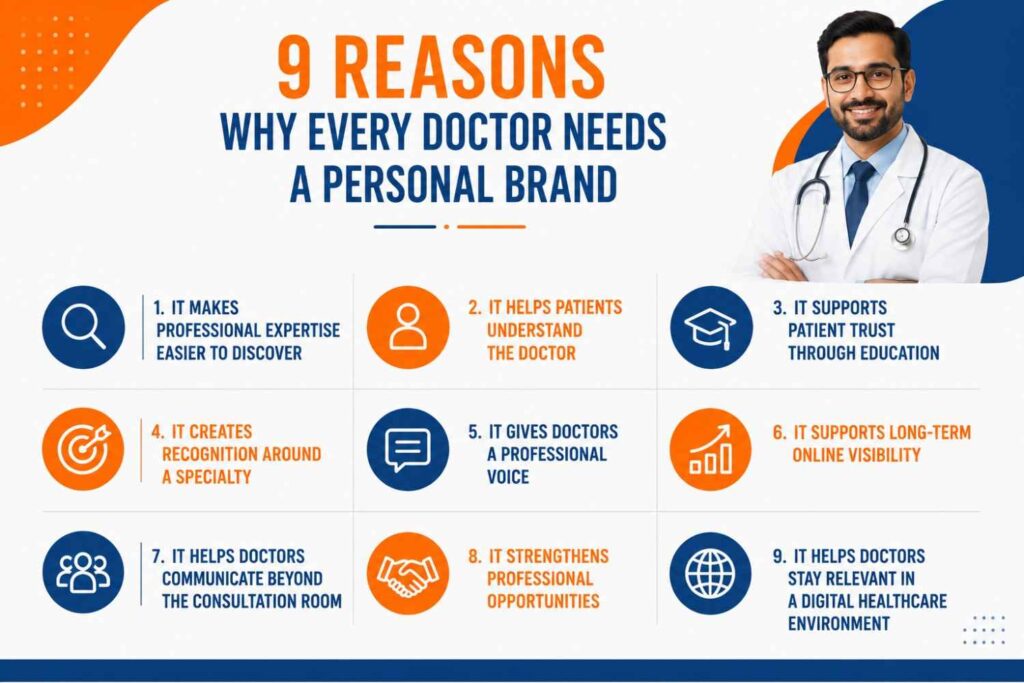
9 Reasons Why Every Doctor Needs a Personal Brand
1. It Makes Professional Expertise Easier to Discover
One important reason why every doctor needs a personal brand is discoverability.
Doctors have years of education, clinical experience, training, and professional knowledge. However, expertise has limited digital visibility if it is not communicated online.
A structured personal brand can help connect a doctor’s name with relevant professional topics.
For example, an orthopedic specialist may regularly publish educational information about:
- Joint health
- Sports injuries
- Fracture care
- Rehabilitation
- Common orthopedic procedures
Over time, these resources can create a stronger association between the doctor’s name and professional area.
2. It Helps Patients Understand the Doctor
A doctor’s qualifications alone may not tell the complete professional story.
Patients may also want to understand:
- Areas of specialization
- Professional interests
- Experience
- Treatment philosophy
- Communication approach
- Educational focus
A personal brand creates space for this information.
Instead of presenting only a name and designation, doctors can create a more complete professional profile.
This can make online research easier for patients who are trying to understand their healthcare options.
3. It Supports Patient Trust Through Education
Trust is important in healthcare.
One effective way to communicate professionally online is through education.
Doctors can explain healthcare topics in simple language through:
- Articles
- Videos
- FAQs
- Social media posts
- Interviews
- Infographics
- Short educational clips
For example, instead of simply promoting a procedure, a doctor could explain what the procedure involves, who may need it, how preparation works, and what patients may generally expect.
Educational communication allows doctors to demonstrate knowledge without relying heavily on promotional language.
4. It Creates Recognition Around a Specialty
Doctors often have specific areas of expertise.
A personal brand can help reinforce those areas through consistent communication.
For example:
A Dermatologist
May focus content around:
- Skin health
- Acne education
- Pigmentation
- Hair and scalp care
- Preventive skin care
A Cardiologist
May focus on:
- Heart health
- Blood pressure awareness
- Cholesterol education
- Preventive cardiology
- Heart-related lifestyle information
An Orthopedic Surgeon
May discuss:
- Joint health
- Sports injuries
- Fracture management
- Rehabilitation
- Surgical recovery
This type of specialization helps create a clearer professional identity.
5. It Gives Doctors a Professional Voice
Every doctor communicates differently.
Some are particularly good at explaining complex subjects. Others may prefer research-based discussions, short educational videos, interviews, or written articles.
A personal brand gives doctors a way to develop a consistent professional voice.
That voice should reflect the doctor’s actual personality and expertise rather than copying another professional.
A clear communication style can make healthcare information easier to recognize and understand.
6. It Supports Long-Term Online Visibility
A personal brand is not built from one social media post.
It develops through a collection of professional digital assets.
These may include:
- Website pages
- Blog articles
- Videos
- Professional profiles
- Interviews
- Educational posts
- Search results
- Social media content
Each useful piece of content can contribute to the doctor’s broader digital presence.
This makes personal branding a long-term activity rather than a short advertising campaign.
7. It Helps Doctors Communicate Beyond the Consultation Room
A doctor’s interaction with patients does not have to begin and end with an appointment.
Educational content can answer common questions before a consultation.
For example, a doctor can publish information about:
- How to prepare for an appointment
- Questions patients may want to ask
- General treatment processes
- Recovery considerations
- Preventive healthcare
- Common misconceptions
This can make professional information accessible to people who are researching a healthcare topic.
8. It Strengthens Professional Opportunities
Personal branding is not only about patients.
A strong professional identity may also help doctors become more visible to:
- Healthcare organizations
- Medical conferences
- Media organizations
- Academic institutions
- Professional networks
- Researchers
- Healthcare businesses
- Other medical professionals
Doctors who consistently share meaningful professional knowledge may become easier to identify when opportunities arise.
This is particularly relevant for doctors interested in teaching, research, speaking, interviews, or professional collaborations.
9. It Helps Doctors Stay Relevant in a Digital Healthcare Environment
Digital healthcare communication continues to evolve.
Search engines, social media, video platforms, online healthcare resources, and AI-powered search systems are changing how people discover information.
Doctors who maintain accurate and useful professional information online can make their expertise easier to understand across these environments.
This is another important reason why every doctor needs a personal brand.
The goal is not to be present everywhere. The goal is to have reliable, consistent, and professionally presented information where the relevant audience is looking.
What Makes a Doctor’s Personal Brand Different?
Doctor branding is different from branding a typical consumer business.
Healthcare involves professional responsibility, patient privacy, medical accuracy, and ethical communication.
A doctor’s personal brand should therefore be built around:
- Expertise
The information should reflect genuine medical knowledge and professional experience.
- Accuracy
Healthcare content should be medically responsible and regularly reviewed where appropriate.
- Transparency
Professional qualifications and experience should be presented accurately.
- Education
Content should aim to help people understand healthcare topics.
- Professionalism
Communication should maintain appropriate standards across every platform.
- Consistency
The doctor’s name, specialty, professional information, and visual identity should remain reasonably consistent.
Personal Brand vs Professional Reputation
These two concepts are related but not identical.
Professional reputation develops through a doctor’s actual work, patient interactions, professional conduct, expertise, and relationships.
Personal branding is how those professional qualities are communicated and presented to the public.
A doctor can have an excellent professional reputation but limited online visibility.
Likewise, a highly visible online profile does not automatically mean strong professional credibility.
The strongest approach is to make the online brand accurately represent the doctor’s real professional reputation.
Where Should Doctors Build Their Personal Brand?
Doctors do not necessarily need to use every digital platform.
The right channels depend on professional goals and audience.
- Professional Website
A website can act as the central information source.
Important pages may include:
- About the Doctor
- Qualifications
- Specialty
- Areas of Expertise
- Procedures or Services
- Educational Resources
- Blog
- FAQs
- Contact Information
- Google Business Profile
A well-maintained profile can help people find essential clinic information and relevant professional details through Google Search and Maps.
- Social Media
Platforms such as Instagram, Facebook, LinkedIn, and YouTube can be selected based on content type and audience.
- Professional Networks
LinkedIn and professional medical platforms can be useful for sharing academic achievements, conferences, research, and professional updates.
How Doctors Can Start Without Feeling Overwhelmed
Building a personal brand does not require publishing content every day.
A practical starting system can be simple.
Start With Three Topics
Choose three areas closely related to your specialty.
Create One Content Day
Record several short educational videos or prepare multiple article ideas during one scheduled session.
Build a Monthly Calendar
Plan topics before publishing.
For example:
| Week | Content |
|---|---|
| Week 1 | Educational article |
| Week 2 | Short video |
| Week 3 | FAQ post |
| Week 4 | Professional update |
Repurpose Useful Content
One detailed article can become:
- A short video
- Three social posts
- An FAQ
- An infographic
- A newsletter topic
This makes content creation more manageable.
How D Plus Connect Can Support Doctor Branding
Building a personal brand requires medical expertise as well as consistent digital execution.
D Plus Connect provides healthcare-focused digital marketing services covering areas such as:
- Social media management
- Content creation
- Brand development
- SEO
- Website optimization
- Strategic advertising
- Video production
- Digital marketing consultation
For doctors who have limited time to manage their digital presence, structured support can help maintain consistency across selected platforms.
The doctor’s medical expertise remains the foundation, while digital strategy can help communicate that expertise effectively.
Conclusion
The question why every doctor needs a personal brand becomes increasingly relevant as healthcare discovery moves further into digital channels.
A personal brand gives doctors a structured way to communicate expertise, educate audiences, strengthen professional visibility, and present accurate information online. It is not about becoming an online celebrity or constantly promoting medical services.
Instead, it is about making genuine professional expertise easier to discover and understand.
Doctors can begin with a simple website, clear professional positioning, useful educational content, and a manageable digital strategy. Over time, these efforts can create a stronger and more recognizable professional identity.
For doctors building their digital presence, the most valuable personal brand is one that reflects real expertise, communicates responsibly, and consistently provides useful information to the people looking for it.For more information about search engine optimization best practices, visit Google’s SEO Starter Guide.

