

DIGITAL MARKETING FOR DOCTORS IN THIRUVANANTHAPURAM
Patients no longer depend only on word-of-mouth recommendations when choosing a healthcare professional. They search online, read educational content, check reviews, compare services, and look for information that helps them feel confident before booking an appointment. This makes digital marketing for doctors in Thiruvananthapuram an important part of building a modern medical practice.
A strong online presence is not simply about advertising a doctor’s services. It is about communicating expertise, providing useful health information, answering common questions, and making it easier for patients to find the right care. When planned correctly, digital marketing can help doctors build visibility while maintaining professionalism and patient trust.For medical professionals, marketing also requires greater care than marketing for many other industries. Healthcare content should be accurate, responsible, informative, and respectful of professional and ethical standards.
What Is Digital Marketing for Doctors?
Digital marketing for doctors refers to the use of online platforms and digital strategies to improve a doctor’s visibility, communicate with potential patients, educate audiences, and support practice growth.
Instead of relying on one advertising channel, a healthcare marketing strategy can combine several methods.
These may include:
- Search engine optimization
- Medical website development
- Google Business Profile optimization
- Social media marketing
- Healthcare content marketing
- Educational blogs
- Search engine advertising
- Social media advertising
- Online reputation management
- Video marketing
- Local SEO
- Patient-focused website optimization
The objective is not simply to generate traffic. The objective is to attract relevant visitors, provide valuable information, and turn online visibility into meaningful patient interactions.
Why Digital Marketing for Doctors Matters Today ?
The way people search for healthcare information has changed significantly. A patient may search for symptoms, treatment options, specialists, procedures, diagnostic tests, or preventive care before contacting a medical professional.
A doctor who has useful and reliable information available online has an opportunity to become visible during this research process.
Patients Search Before They Book
A potential patient may want to know:
- What conditions does the doctor treat?
- What treatments are available?
- What should I expect during a consultation?
- Is the doctor experienced in a particular area?
- Where can I find appointment information?
- What questions should I ask during my consultation?
A professional website and well-planned content can answer these questions before the patient makes contact.
Visibility Supports Patient Education
Healthcare marketing should not be limited to promotional messages. Educational content can help people understand medical topics in simple language.
Doctors can create content around:
- Common symptoms
- Prevention
- Treatment options
- Diagnostic procedures
- Recovery guidance
- Frequently asked questions
- General health awareness
- When professional medical attention may be appropriate
Useful information can strengthen online credibility while helping patients make more informed decisions.
Key Elements of Digital Marketing for Doctors
A successful strategy usually involves multiple digital channels working together rather than one isolated activity.
1. Search Engine Optimization
Search engine optimization, or SEO, helps a medical website appear when people search for relevant healthcare information.
Medical SEO can include:
- Keyword research
- Service-page optimization
- Location-based search optimization
- Technical SEO
- Internal linking
- Page-speed improvements
- Metadata optimization
- Helpful blog content
- Structured website architecture
For example, individual pages can be developed around specific treatments, specialties, procedures, and patient questions.
The focus should be on creating genuinely useful pages rather than publishing large quantities of repetitive content.
2. Local SEO
Local SEO is especially valuable for doctors because healthcare services are often location-dependent.
A properly optimized Google Business Profile can help potential patients find important information such as:
- Practice name
- Address
- Phone number
- Working hours
- Website
- Services
- Directions
- Patient reviews
Consistency is important. Business information should remain accurate across relevant online platforms.
3. Medical Website Optimization
A doctor’s website is often the central destination for online marketing.
A professional healthcare website should make essential information easy to find.
Important website sections may include:
- About the doctor
- Medical specialty
- Treatments and procedures
- Conditions treated
- Patient education
- Frequently asked questions
- Appointment information
- Contact details
- Location information
The website should also work properly on smartphones because many patients search for healthcare information using mobile devices.
4. Healthcare Content Marketing
Content marketing allows doctors to communicate knowledge through useful articles and resources.
A medical blog can answer questions that patients commonly search for online.
Examples include:
- What are the early signs of a particular condition?
- When should someone consult a specialist?
- How does a diagnostic procedure work?
- What happens during treatment?
- What factors can affect recovery?
- How can a condition be prevented?
Content should be written clearly and reviewed for medical accuracy.
Benefits of Digital Marketing for Doctors
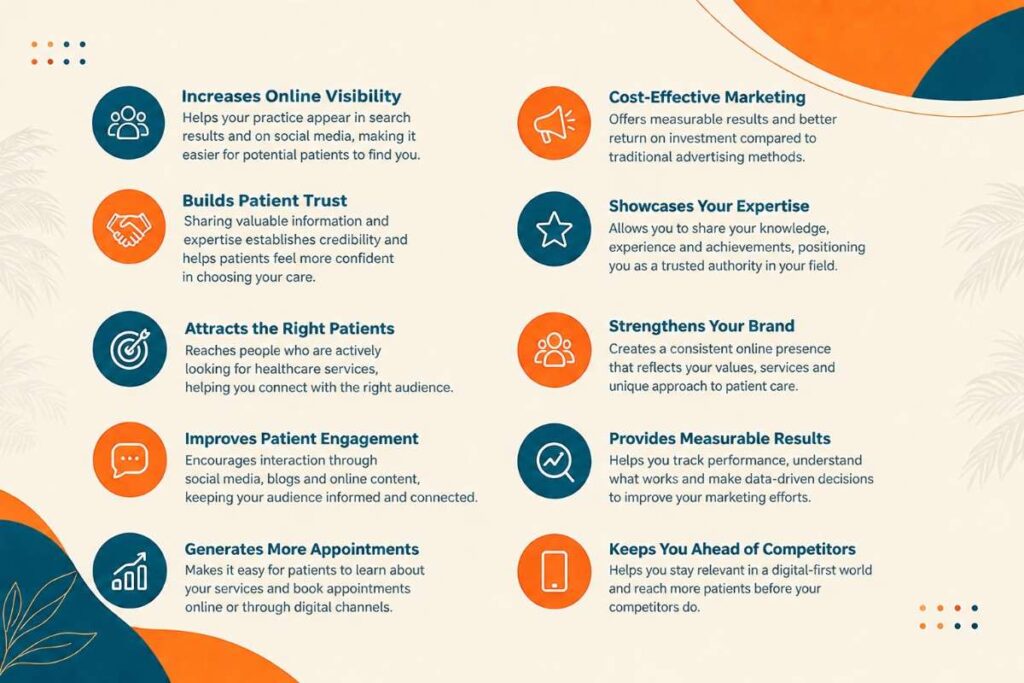
When implemented responsibly, digital marketing can provide several benefits for a medical practice.
Improved Online Visibility
SEO and local search strategies can help a doctor’s practice become easier to discover online.
Instead of depending entirely on traditional referrals, doctors can build visibility across search engines, websites, business listings, and social platforms.
Better Patient Communication
A website and social media presence can provide patients with useful information before they make an appointment.
This can reduce uncertainty and help people understand what type of care may be relevant to them.
Stronger Professional Presence
A well-organized website containing informative content can communicate a doctor’s areas of expertise and professional focus.
Educational content can also demonstrate knowledge without relying on exaggerated promotional claims.
Increased Organic Traffic
Search engine optimization can generate visitors through unpaid search results.
High-quality pages targeting relevant patient questions may continue attracting traffic over time.
Better Patient Engagement
Social media and content platforms allow doctors to share general health education regularly.
This creates opportunities for ongoing communication with an audience while keeping content informative and responsible.
Types of Digital Marketing for Doctors
There is no single marketing method that works for every medical specialty.
Organic Search Marketing
Organic search focuses on improving visibility in unpaid search results.
It includes:
- SEO
- Blogging
- Local SEO
- Technical optimization
- Internal linking
- Helpful content
Paid Search Advertising
Search advertising can place relevant advertisements in front of people actively searching for particular services.
Campaigns should be carefully planned, with appropriate keywords, landing pages, budgets, and conversion tracking.
Social Media Marketing
Social platforms can be used for health education, awareness campaigns, professional updates, and general patient information.
Suitable content can include:
- Health tips
- Awareness posts
- Educational graphics
- Short videos
- Frequently asked questions
- General explanations of procedures
Video Marketing
Video can simplify complex healthcare topics.
Doctors can use short educational videos to explain general concepts, procedures, preventive measures, or frequently asked questions.
The emphasis should remain educational rather than making unrealistic promises.
How to Build an Effective Digital Marketing Strategy
A successful healthcare marketing plan should begin with clear objectives.
Step 1: Define the Target Audience
Understand the types of patients the practice intends to serve.
Consider:
- Medical concerns
- Age groups
- Common search behavior
- Treatment interests
- Geographic reach
- Information needs
This makes content more relevant.
Step 2: Research Patient Search Intent
Keyword research should identify what potential patients are actually searching for.
Search terms may relate to:
- Symptoms
- Treatments
- Medical conditions
- Procedures
- Specialists
- Costs
- Recovery
- Prevention
Search intent is more important than simply selecting keywords with high search volume.
Step 3: Create Useful Website Pages
Each important service or specialty should have a dedicated, informative page.
A good page should explain:
- What the service is
- Who may need it
- How it generally works
- What patients should know
- Frequently asked questions
- How to contact the practice
Step 4: Publish Consistent Content
A healthcare blog should answer genuine patient questions.
Consistency is useful, but quality should always come before quantity.
A smaller number of well-researched articles can be more valuable than many shallow posts.
Step 5: Improve Local Search Visibility
Keep business information accurate and consistent.
Encourage patients to use legitimate review platforms where appropriate, while ensuring that all review and testimonial practices comply with applicable professional and regulatory requirements.
Step 6: Measure Performance
Digital marketing should be measured regularly.
Useful metrics include:
- Organic traffic
- Search impressions
- Keyword rankings
- Website engagement
- Appointment enquiries
- Conversion rates
- Advertising performance
- Local search visibility
Analytics can reveal which strategies are producing useful results and where improvements are needed.
Common Mistakes to Avoid
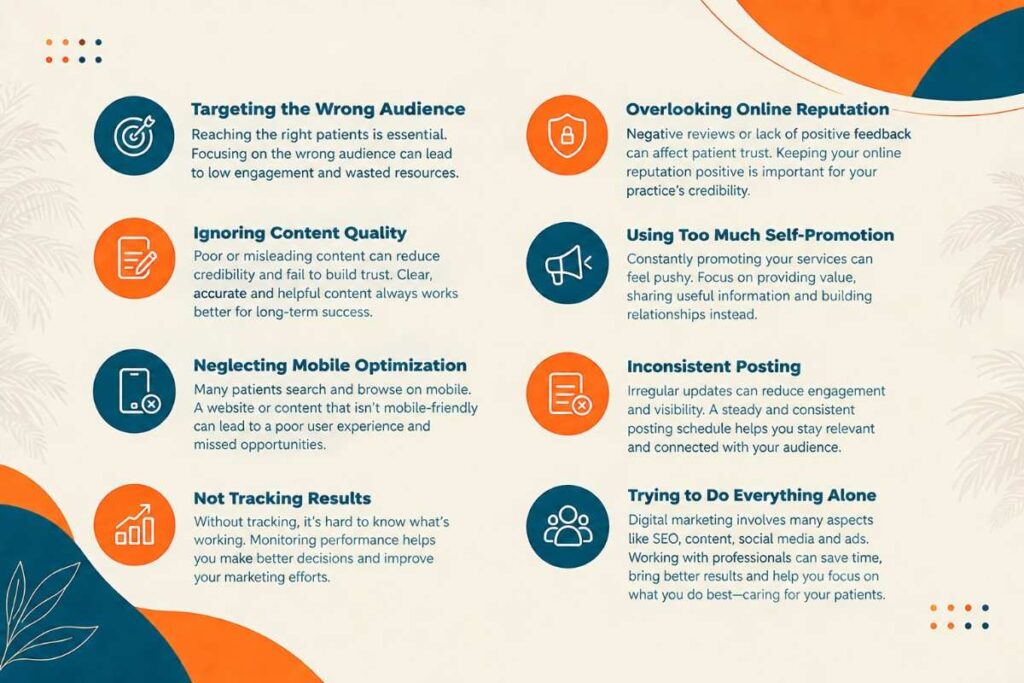
Even a well-funded healthcare marketing campaign can struggle if the basic strategy is wrong.
Using Too Much Promotional Language
Patients generally want useful information when researching healthcare.
Exaggerated claims can reduce credibility and may create ethical or compliance concerns.
Publishing Thin Content
Short articles created only to target keywords rarely provide much value.
Healthcare content should answer the patient’s question properly.
Ignoring Mobile Users
A website that is difficult to navigate on a smartphone can create a poor experience.
Mobile responsiveness should therefore be a basic requirement.
Neglecting Local SEO
A doctor may have a good website but still miss local search opportunities if the business profile and location-related information are poorly optimized.
Focusing Only on Social Media
Social media can be useful, but it should not replace a strong website and search strategy.
Search engines, websites, local listings, content, and social channels can work together as part of a broader strategy.
Tips for Better Digital Marketing for Doctors
A few practical principles can improve long-term performance.
- Prioritize accurate healthcare information.
- Write for patients rather than search engines.
- Use simple language for complex subjects.
- Keep important website information updated.
- Optimize pages for mobile devices.
- Use relevant internal links.
- Create content around genuine patient questions.
- Monitor website performance regularly.
- Maintain consistent business information.
- Follow applicable healthcare advertising and professional guidelines.
- Avoid misleading guarantees or unrealistic outcomes.
- Protect patient privacy in every digital activity.
The Role of Trust in Healthcare Marketing
Trust is one of the most important factors in healthcare communication.Patients are making decisions that can affect their health and wellbeing. They therefore need information that feels reliable and understandable.
Trust can be strengthened through:
Accurate Information
Medical content should be carefully researched and medically appropriate.
Professional Presentation
A clean website with clear navigation makes it easier for visitors to find information.
Transparent Communication
Information about services, appointment processes, and contact options should be straightforward.
Educational Content
Helpful articles and videos can demonstrate a commitment to patient education.
Consistency
The information presented across websites, business profiles, and social channels should be consistent and current.
How Often Should Doctors Publish Content ?
There is no universal number of articles that every doctor needs to publish.
A realistic schedule is better than publishing content inconsistently.
For example, a practice might develop:
- Educational blog articles
- Frequently asked question pages
- Short social media posts
- Educational videos
- Seasonal health awareness content
The key is to maintain quality, accuracy, and consistency.
How Long Does Digital Marketing Take to Produce Results?
Results vary depending on the specialty, competition, website quality, existing online authority, content quality, and marketing budget.SEO generally requires patience because search visibility develops over time.Paid campaigns can generate visibility more quickly, but they require ongoing monitoring and optimization.A balanced strategy can combine short-term campaigns with long-term organic growth.
Conclusion
A successful online presence is built through consistent, useful, and responsible communication rather than simply publishing advertisements. Digital marketing for doctors in Thiruvananthapuram can bring together SEO, local search, healthcare content, websites, social media, video, and paid campaigns to create a stronger digital presence.The most effective approach begins with understanding patient search behavior and then providing clear, accurate, and valuable information at each stage of the online journey. By combining professional content with technical SEO, local visibility, a user-friendly website, and regular performance measurement, doctors can create a sustainable digital marketing strategy that supports patient education and practice growth. For practical guidance on improving website visibility and creating search-friendly content, visit Google Search Central.
Frequently Asked Questions
1. What is digital marketing for doctors?
Digital marketing for doctors uses online channels such as SEO, websites, social media, content marketing, local search, and online advertising to improve visibility and communicate with potential patients.
2. Why is SEO important for doctors?
SEO can help healthcare websites appear when potential patients search for relevant medical information, treatments, conditions, and services.
3. Can digital marketing help a new medical practice?
Yes. A new practice can use a professional website, local SEO, educational content, and carefully managed advertising to establish an online presence.
4. Is social media necessary for doctors?
Social media can be useful for sharing general health education and maintaining audience engagement. However, the right platforms depend on the doctor’s objectives and audience.
5. What type of content should doctors publish?
Doctors can publish educational content about common conditions, treatments, procedures, prevention, symptoms, and frequently asked patient questions.
6. How important is a medical website?
A website can serve as the central source of information about a doctor’s specialty, services, educational resources, and appointment process.
7. Does local SEO help doctors?
Yes. Local SEO can make a medical practice easier to discover when people search for healthcare services within a specific geographic area.
8. Should doctors use paid advertising?
Paid advertising can be useful when campaigns are carefully targeted and managed. It should complement, rather than necessarily replace, organic search and educational content.
9. How can doctors build online trust?
Doctors can build trust by publishing accurate information, maintaining a professional website, communicating clearly, keeping information updated, and following applicable professional standards.
10. How much does digital marketing for doctors cost?
The cost varies depending on the services required, competition, advertising budget, website requirements, content volume, and marketing objectives. There is no single price suitable for every practice.

