

FAQs Doctors Should Answer Online
Patients often have questions before they decide to contact a doctor. They may search online to understand a medical term, learn about a procedure, prepare for an appointment, or simply find reliable general information. This is why FAQs doctors should answer online can become an important part of a professional healthcare website and digital content strategy.
A well-planned FAQ section does more than fill space on a website. It can address common concerns, make medical information easier to understand, improve website navigation, and help people find answers to questions they may otherwise hesitate to ask.
For doctors and healthcare organizations, answering the right questions online can also create a more informative digital presence. The focus should remain on accurate, general education rather than providing individual diagnoses or making promises about treatment outcomes.
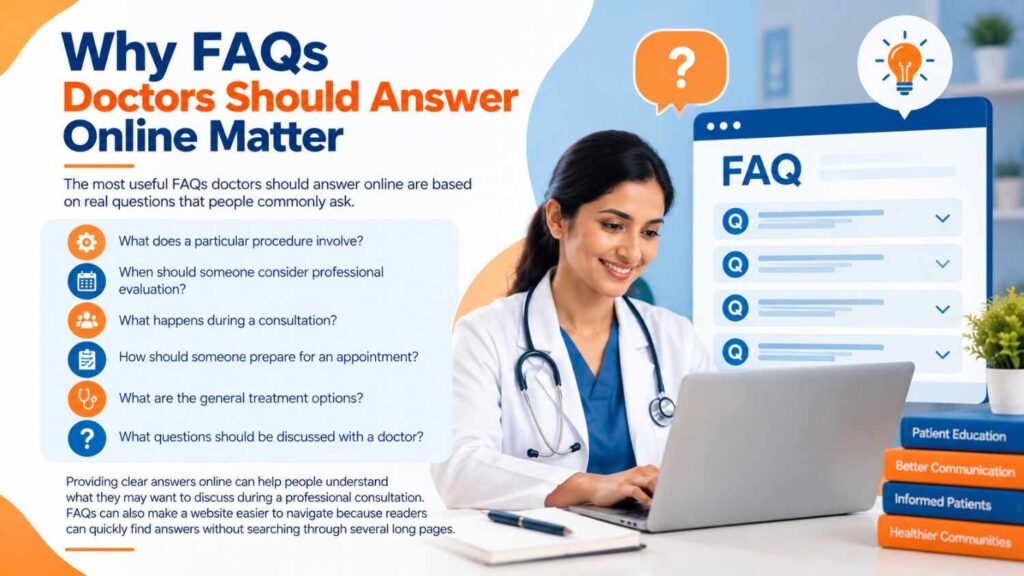
Why FAQs Doctors Should Answer Online Matter
The most useful FAQs doctors should answer online are based on real questions that people commonly ask.
A patient may want to know:
- What does a particular procedure involve?
- When should someone consider professional evaluation?
- What happens during a consultation?
- How should someone prepare for an appointment?
- What are the general treatment options?
- What questions should be discussed with a doctor?
Providing clear answers online can help people understand what they may want to discuss during a professional consultation.
FAQs can also make a website easier to navigate because readers can quickly find answers without searching through several long pages.
What Makes a Good Online FAQ?
Before discussing the specific FAQs doctors should answer online, it is useful to understand what makes an FAQ effective.
A good healthcare FAQ should be:
- Clear
- Accurate
- Concise
- Relevant
- Easy to read
- Professionally written
- Based on genuine questions
- Appropriate for general education
The answer should address the question directly before adding additional context.
Avoid turning every FAQ into a promotional message. The purpose should be to educate and guide readers.
11 FAQs Doctors Should Answer Online
1. What Does This Medical Condition or Procedure Mean?
One of the most important FAQs doctors should answer online is a basic definition.
Medical terminology can be unfamiliar to patients. A doctor can explain the term in simple language before discussing more detailed information.
A useful answer can include:
- A simple definition
- What the term generally refers to
- Why it may be discussed
- Basic information readers should understand
This gives visitors a starting point before they explore more detailed content.
2. When Should Someone Consult a Doctor?
People often want to know when professional guidance may be appropriate.
An online FAQ can explain general situations in which consultation may be considered without attempting to diagnose individual readers.
The answer should avoid alarmist language.
Instead, it can encourage readers to discuss persistent, concerning, or unexplained issues with an appropriate qualified professional.
3. What Happens During the First Consultation?
This is one of the most practical FAQs doctors should answer online.
People may feel more comfortable when they know what a consultation generally involves.
An answer could explain that a consultation may include:
- Discussion of medical history
- Questions about the concern
- Relevant examination
- Review of existing reports where appropriate
- Discussion of possible next steps
The exact process varies according to the specialty and individual circumstances.
4. How Should I Prepare for My Appointment?
Preparation-related questions are highly useful for healthcare websites.
Depending on the type of consultation, general preparation may involve:
- Bringing relevant medical records
- Listing current medications
- Preparing questions
- Bringing previous reports when requested
- Arriving with the required information
Doctors can customize this FAQ according to their specialty and appointment type.
5. What Treatment Options Are Available?
Patients often search for treatment information before speaking with a doctor.
An FAQ can introduce the general approaches used for a particular condition or situation.
However, it should make clear that treatment decisions depend on individual factors.
A responsible answer should avoid suggesting that one option is automatically appropriate for everyone.
How Doctors Can Structure Treatment FAQs
A useful structure is:
Treatment options → Factors considered → General process → Importance of professional evaluation
This provides information without turning a general FAQ into individualized medical advice.
6. How Is a Diagnosis Made?
Another important question among FAQs doctors should answer online is how a condition is evaluated.
The answer can explain that assessment may involve:
- Medical history
- Physical examination
- Laboratory tests
- Imaging
- Specialized investigations
- Clinical evaluation
Not every patient needs every type of test.
Explaining the general process can help readers understand why professional evaluation matters.
7. How Long Does Treatment Usually Take?
People naturally want to understand timelines.
However, doctors should be careful when answering this question because treatment duration can vary significantly.
A responsible FAQ can explain the factors that may influence the timeline, such as:
- Individual health circumstances
- Type of treatment
- Severity or complexity
- Response to treatment
- Follow-up requirements
Instead of providing an unrealistic fixed timeline, explain why individual experiences can differ.
8. What Should I Expect During Recovery?
Recovery-related questions are among the most useful FAQs doctors should answer online for procedure-focused websites.
An answer can provide general information about:
- Follow-up appointments
- Activity considerations
- General aftercare
- Monitoring
- Returning to normal activities
Specific recovery instructions should always come from the treating healthcare professional.
9. Are There Alternatives to This Treatment?
People may want to understand whether different approaches exist.
An FAQ can explain that treatment options may vary depending on diagnosis, individual circumstances, medical history, preferences, and professional assessment.
This type of content encourages informed discussion rather than presenting healthcare decisions as one-size-fits-all.
10. What Questions Should I Ask My Doctor?
This is an excellent FAQ because it turns the website into a preparation resource.
Doctors can encourage readers to ask questions such as:
- What does my diagnosis mean?
- What are my treatment options?
- What are the potential benefits and considerations?
- Are there alternatives?
- What follow-up may be required?
- What should I know before making a decision?
Encouraging questions can support better communication between patients and healthcare professionals.
11. Where Can I Learn More About This Topic?
The final question among these FAQs doctors should answer online can guide visitors toward additional reliable resources.
A healthcare website can link to:
- Related blog articles
- Procedure pages
- Educational videos
- Patient information resources
- Relevant professional organizations
- Additional FAQs
This creates a connected educational experience rather than leaving readers with one isolated answer.
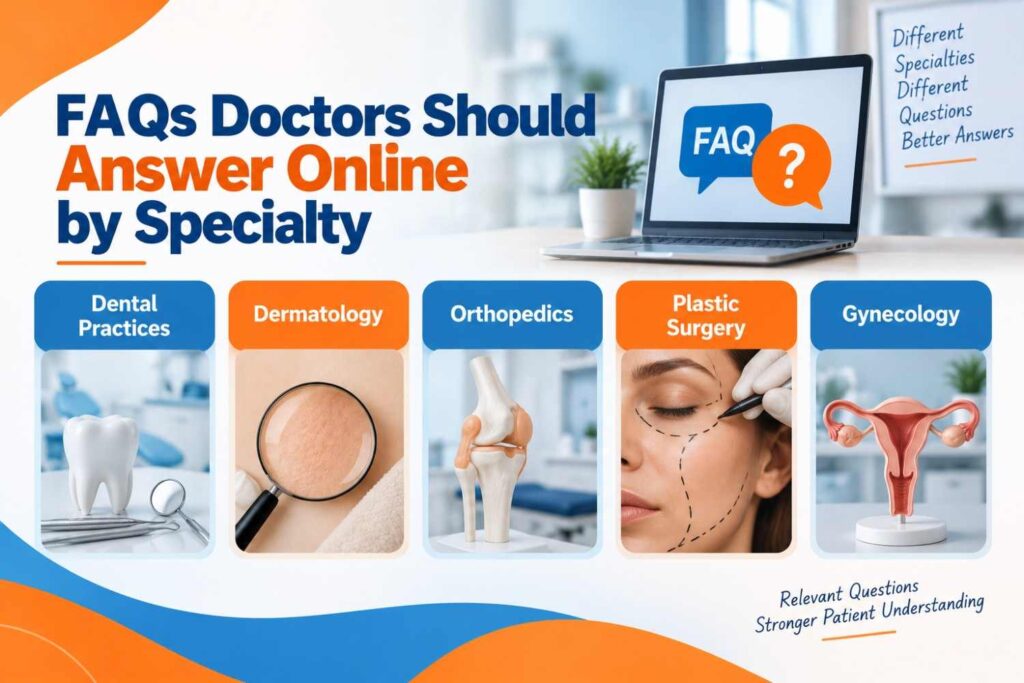
FAQs Doctors Should Answer Online by Specialty
Different specialties naturally require different FAQ topics.
Dental Practices
Possible questions include:
- How often should dental check-ups be scheduled?
- What does professional dental cleaning involve?
- What are the different types of braces?
- How does tooth restoration work?
Dermatology
Potential topics include:
- What does a skin consultation involve?
- How is a skin concern evaluated?
- What are common skincare considerations?
- What should I discuss before a cosmetic procedure?
Orthopedics
Useful questions may include:
- What does an orthopedic consultation involve?
- How are joint problems evaluated?
- What are the general treatment options?
- What does rehabilitation involve?
Plastic Surgery
Possible questions include:
- What is reconstructive surgery?
- What does a surgical consultation involve?
- What factors influence treatment planning?
- What should patients discuss before a procedure?
Gynecology
Potential FAQs can cover:
- What happens during a routine consultation?
- What should I bring to an appointment?
- When should I discuss a particular concern with a gynecologist?
- What types of evaluations may be recommended?
The important point is to adapt FAQs to the specialty instead of using the same generic questions on every healthcare website.
Common Mistakes in Healthcare FAQs
Making Answers Too Long
An FAQ should not become a full article unless the subject genuinely requires extensive explanation.
Using Excessive Medical Terminology
Readers may struggle to understand highly technical answers.
Copying FAQs From Other Websites
FAQ content should reflect the doctor’s specialty and audience.
Using Generic Questions
A relevant FAQ is more valuable than a large collection of unrelated questions.
Making Every Answer Promotional
Educational questions should receive educational answers.
Providing Individual Medical Advice
Online FAQs should not replace professional assessment.
Leaving Information Outdated
Healthcare content should be reviewed periodically to ensure it remains appropriate and accurate.
Conclusion
The most valuable FAQs doctors should answer online are not necessarily the longest or most technical questions. They are the questions people genuinely want answered before, during, or after exploring a healthcare topic.
A well-planned FAQ section can make a medical website more useful by explaining terminology, introducing procedures, discussing general treatment approaches, preparing people for consultations, and directing readers toward additional educational resources.
Doctors can begin by collecting the questions they hear most frequently and organizing them into clear categories. These questions can then become FAQs, blog topics, videos, social media content, and other educational resources.
When healthcare websites consistently answer relevant questions with accurate and understandable information, they create a stronger foundation for patient education and professional digital communication. A thoughtful collection of FAQs doctors should answer online can therefore become an important part of a long-term healthcare content strategy.For more information about search engine optimization best practices, visit Google’s SEO Starter Guide.

