

Why Educational Videos Build Trust
People are surrounded by information every day, but finding information they can understand and rely on is not always easy. This is one reason why educational videos build trust across healthcare, education, professional services, and many other industries. Videos can explain ideas visually, answer common questions, and allow audiences to understand a subject before making a decision.
Unlike content that focuses only on promoting a service, educational videos provide something useful first. They can introduce a topic, explain a process, clarify common misunderstandings, and present professional knowledge in an accessible format.
For healthcare brands especially, trust is closely connected with how clearly and responsibly information is communicated. A well-planned educational video can help audiences become familiar with a professional’s expertise and communication style without relying on exaggerated promotional messages.
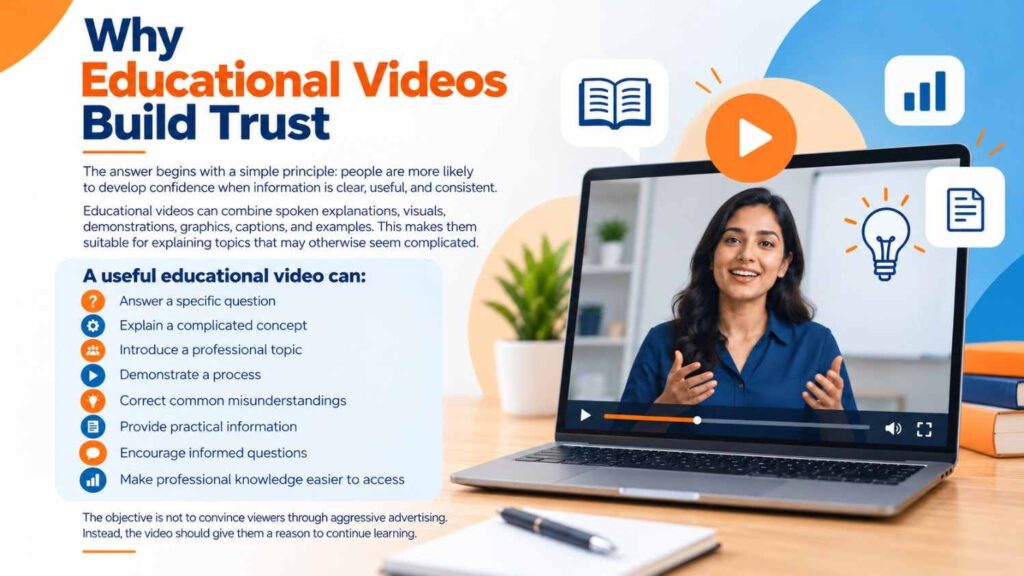
Why Educational Videos Build Trust
The answer begins with a simple principle: people are more likely to develop confidence when information is clear, useful, and consistent.
Educational videos can combine spoken explanations, visuals, demonstrations, graphics, captions, and examples. This makes them suitable for explaining topics that may otherwise seem complicated.
A useful educational video can:
- Answer a specific question
- Explain a complicated concept
- Introduce a professional topic
- Demonstrate a process
- Correct common misunderstandings
- Provide practical information
- Encourage informed questions
- Make professional knowledge easier to access
The objective is not to convince viewers through aggressive advertising. Instead, the video should give them a reason to continue learning.
9 Reasons Why Educational Videos Build Trust
1. They Demonstrate Knowledge
One of the strongest reasons why educational videos build trust is that they allow professionals to demonstrate what they know.
A written profile may list qualifications and experience, but a video can show how a professional explains a topic.
For example, a healthcare professional can create a short video explaining:
- A commonly asked health question
- A general procedure overview
- Preventive care information
- Frequently misunderstood terminology
- Questions to discuss during a consultation
The audience gets an opportunity to learn from the professional rather than simply reading promotional statements about them.
2. Videos Make Complex Information Easier to Understand
- Some subjects are difficult to communicate through text alone.
- A long paragraph may explain a process, while a video can combine narration with diagrams, illustrations, animations, or simple examples.
- This is particularly useful for professional and technical subjects.
An effective educational video can break information into smaller sections:
Topic → Explanation → Visual example → Key points → Summary
This structure helps viewers follow the information without feeling overwhelmed.
3. They Put a Human Voice Behind the Information
- Another important reason why educational videos build trust is the human element.
- Audiences do not only receive information. They also experience the speaker’s communication style.
- Tone of voice, clarity, pacing, and presentation can make professional information feel more approachable.
- A person who regularly explains useful topics can gradually become familiar to the audience.
- That familiarity can contribute to a stronger digital relationship over time.
4. Educational Videos Answer Real Questions
Trust is often built by being useful.
Instead of creating videos around generic promotional messages, organizations can identify questions their audience is already asking.
Examples include:
- What does this service involve?
- How does this process work?
- What should someone know before getting started?
- What is the difference between two commonly confused options?
- What questions should a person ask a professional?
- What does a particular technical term mean?
When videos consistently answer genuine questions, audiences have a practical reason to watch them.
Types of Educational Videos That Can Build Trust
Understanding different formats can further explain why educational videos build trust.
Explainer Videos
These introduce a topic in simple language.
They work well for unfamiliar concepts, services, procedures, and professional terminology.
FAQ Videos
A professional can answer one frequently asked question in each video.
This format is easy to understand and can also create a useful collection of educational resources.
How-To Videos
These demonstrate a process step by step.
Depending on the industry, this could involve using a product, understanding a service, following a general process, or learning a practical skill.
Myth and Fact Videos
These address common misunderstandings by presenting clear explanations.
The information should remain responsible and avoid sensational claims.
Educational Series
Instead of explaining everything in one long video, a complicated subject can be divided into several short episodes.
For example:
- Part 1: Understanding the topic
- Part 2: Common questions
- Part 3: Important considerations
- Part 4: Professional guidance
- Part 5: Frequently asked questions
Professional Insight Videos
Experts can discuss developments, general knowledge, industry concepts, or educational topics related to their field.
How Educational Videos Support Professional Credibility
Professional credibility is developed through repeated evidence of knowledge and responsible communication.
Educational videos can support this by allowing professionals to discuss subjects within their area of expertise.
A strong video should:
- Present accurate information
- Use understandable language
- Stay relevant to the topic
- Avoid unsupported claims
- Explain limitations when necessary
- Encourage appropriate professional guidance
- Maintain a consistent presentation style
The goal is not to make every video highly technical.
In fact, simplifying a complicated subject without losing its meaning can demonstrate strong communication skills.

The Role of Consistency in Trust Building
One video may attract attention, but why educational videos build trust becomes more apparent when educational content is published consistently.Imagine a professional who publishes one useful video every week.
Over time, viewers may encounter videos about:
- Common questions
- Basic concepts
- Professional advice
- Industry updates
- Frequently misunderstood topics
- Practical information
The audience begins to associate the professional with useful knowledge.Consistency can also create a recognizable content identity.
This does not mean publishing videos every day. A realistic schedule is more useful than an ambitious schedule that cannot be maintained.
Why Educational Videos Build Trust Through Transparency
Transparency is another major factor.People may have questions about a service, procedure, product, or professional process but hesitate to ask immediately.Educational videos can provide preliminary information that helps them understand what they may want to discuss later.For healthcare content, for example, a video can explain a general process without pretending to provide an individual diagnosis.
Responsible communication can include statements such as:
- Individual situations can vary.
- Professional evaluation may be appropriate.
- The information is intended for general education.
- A qualified professional can provide guidance based on individual circumstances.
This type of communication can make educational content more responsible and credible.
Educational Videos and Search Engine Optimization
SEO is another reason why educational videos build trust as part of a broader digital strategy.
People often search questions rather than specific brands.
For example, someone may search:
- What is this procedure?
- How does this treatment work?
- What is the difference between these options?
- What should I know before consultation?
- What are the important questions to ask?
Creating videos around relevant questions can support a broader content strategy.
The same topic can potentially be developed into:
- A video
- A blog article
- An FAQ
- A social media post
- An infographic
- A website resource
This creates multiple ways for people to access the same educational information.
Conclusion
Why educational videos build trust can be understood through their ability to combine knowledge, clarity, transparency, and human communication. Instead of simply telling an audience that a professional is knowledgeable, videos provide an opportunity to demonstrate that knowledge through useful explanations.
From short FAQ clips to detailed educational presentations, video content can make complex subjects easier to understand and create repeated opportunities for meaningful audience interaction.
The most effective approach is to focus on genuine questions, provide accurate information, communicate naturally, and maintain consistency. Over time, these efforts can help create a digital presence associated with useful and responsible information.
Ultimately, why educational videos build trust is not just about the video format itself. Trust comes from the quality of the information, the credibility of the communicator, and the value provided to the viewer. For organizations and professionals building a stronger digital presence in Kerala, educational video content can be an effective part of a thoughtful, audience-focused communication strategy.For more information about search engine optimization best practices, visit Google’s SEO Starter Guide.

