
SEO vs Google Ads for Hospitals: 7 Powerful Methods Compared
Choosing between SEO vs Google Ads for Hospitals is an important decision for healthcare organisations that want to attract qualified patient enquiries online. Hospitals in Kerala increasingly depend on search engines to connect with people researching doctors, departments, treatments, diagnostic services, and appointment options.
Both search engine optimisation and Google Ads can improve visibility, but they work differently. SEO focuses on building sustainable organic rankings, while Google Ads provides paid placement for selected search terms.
Understanding SEO vs Google Ads for Hospitals helps hospital administrators, doctors, marketing managers, and healthcare business owners decide where to invest their budgets. The right decision depends on the hospital’s goals, competition, specialties, website condition, location, and desired timeline.
What Is SEO for Hospitals?
Hospital SEO is the process of improving a healthcare website so that it appears more prominently in unpaid Google search results.
When patients search for a doctor, department, medical service, diagnostic test, or treatment, SEO helps relevant hospital pages become easier to find.
SEO may include:
- Healthcare keyword research
- Treatment page optimisation
- Doctor profile optimisation
- Technical website improvements
- Local SEO
- Google Business Profile optimisation
- Medical content creation
- Internal linking
- Website speed optimisation
- Mobile usability improvements
- Authority and backlink development
- Search performance monitoring
In the comparison of SEO vs Google Ads for Hospitals, SEO is usually considered the long-term strategy. It requires consistent work, but successful pages may continue attracting visitors without paying for every click.
What Are Google Ads for Hospitals?
Google Ads is a paid advertising platform that allows hospitals to display advertisements when people search for selected keywords.
For example, a hospital may run an advertisement for searches related to cardiology appointments, maternity services, diagnostic scans, dental care, urology consultations, or specialist doctors.
Hospitals generally pay when someone clicks the advertisement. This model is commonly called pay-per-click advertising.
Google Ads campaigns may include:
- Search advertisements
- Call-focused advertisements
- Location-based campaigns
- Display advertisements
- Video advertisements
- Remarketing campaigns
- Performance Max campaigns
- Appointment landing pages
- Conversion tracking
In SEO vs Google Ads for Hospitals, Google Ads is usually the faster option because advertisements can begin appearing soon after a campaign is approved and activated.
However, visibility normally reduces when the advertising budget is paused.
Why Hospitals Need to Compare SEO and Google Ads
Hospitals often invest in digital marketing without clearly understanding how organic and paid search support different stages of patient acquisition.
A hospital may expect SEO to produce immediate results or may continue spending heavily on advertisements without developing a long-term organic presence.
The need to compare SEO vs Google Ads for Hospitals is commonly caused by:
Increasing Online Competition
Hospitals, clinics, diagnostic centres, and individual specialists often target similar healthcare keywords. This makes it difficult to achieve visibility without a structured strategy.
Changing Patient Search Behaviour
Patients frequently use Google to research symptoms, specialists, hospital facilities, appointment availability, reviews, directions, and treatment information.
Limited Marketing Budgets
Hospital marketing teams must decide how much to invest in long-term growth and how much to reserve for immediate campaigns.
New Department Launches
A newly launched department may need fast visibility before its organic pages have gained strong search rankings.
Seasonal Healthcare Demand
Some services may receive increased search interest during specific seasons, awareness months, health campaigns, or vaccination periods.
Weak Organic Rankings
Hospitals with limited website content, technical errors, or poor local optimisation may struggle to appear naturally in search results.
Inconsistent Appointment Enquiries
A hospital may receive strong traffic but few enquiries, or it may depend too heavily on one advertising channel.
These factors make a proper SEO vs Google Ads for Hospitals analysis essential before selecting a marketing plan.
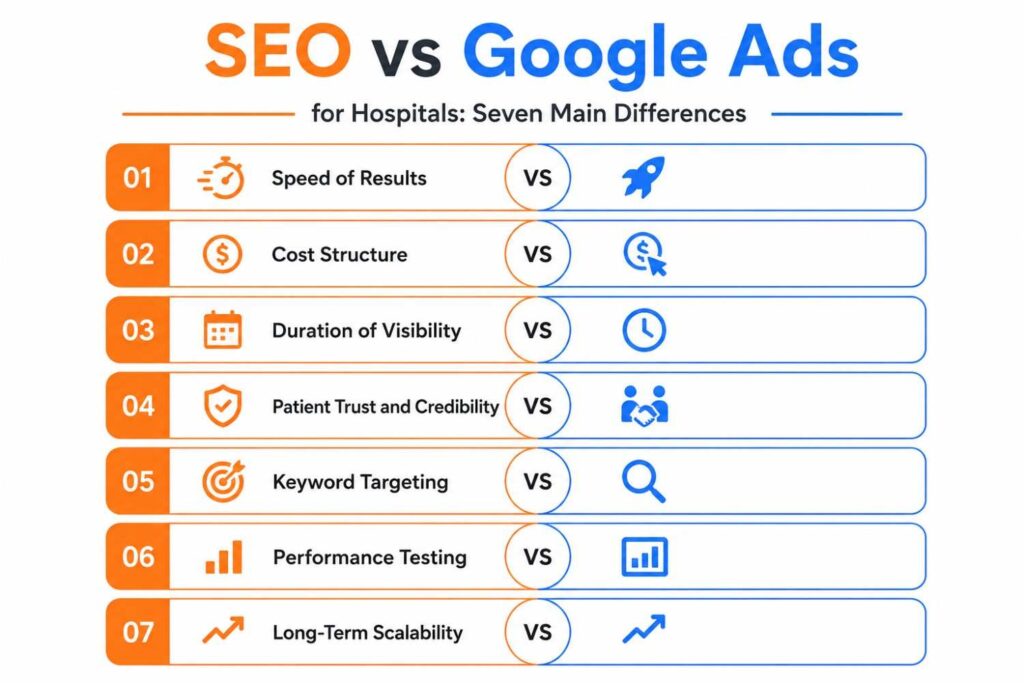
SEO vs Google Ads for Hospitals: Seven Main Differences
1. Speed of Results
Google Ads can provide visibility relatively quickly. Once the advertisement, keywords, budget, targeting, and landing page are ready, the campaign may begin generating impressions and clicks.
SEO normally takes longer because Google must discover, understand, evaluate, and rank the website.
SEO results depend on:
- Current website authority
- Quality of existing content
- Technical website condition
- Keyword competition
- Local competition
- Content publishing consistency
- Backlink quality
- User experience
In SEO vs Google Ads for Hospitals, Google Ads has the advantage when immediate visibility is required. SEO is stronger when the goal is sustainable search growth.
2. Cost Structure
SEO usually requires investment in strategy, content, technical improvements, local optimisation, website updates, and performance analysis.
Hospitals do not pay Google each time someone clicks an organic result.
Google Ads requires a campaign budget in addition to professional management, landing page development, tracking, and optimisation.
The amount spent may vary according to:
- Keyword competition
- Service category
- Geographic targeting
- Campaign objective
- Advertisement quality
- Landing page relevance
- Bidding strategy
- Competitor activity
The cost difference in SEO vs Google Ads for Hospitals should not be judged only by monthly spending. Hospitals should compare cost per qualified enquiry, appointment conversion rate, patient value, and long-term return.
3. Duration of Visibility
SEO pages can continue receiving organic traffic after they develop strong rankings, provided they remain useful, accurate, technically healthy, and regularly updated.
Google Ads visibility generally continues only while the campaign has sufficient budget and remains active.
This does not mean SEO is permanent. Search rankings may change because of:
- Competitor improvements
- Search algorithm updates
- Outdated content
- Technical problems
- Poor website experience
- Changes in patient search patterns
However, in SEO vs Google Ads for Hospitals, SEO creates a more durable digital asset because optimised pages can support visibility over an extended period.
4. Patient Trust and Credibility
Some patients trust organic search results because they view high-ranking hospital pages as relevant and authoritative.
A detailed treatment page, qualified doctor profile, clear FAQ section, accurate contact information, and professional website can strengthen confidence before an appointment.
Google Ads can also build visibility and connect patients with suitable services. Advertisements are particularly helpful when the message is relevant and the landing page provides clear information.
For trust-building, the ideal SEO vs Google Ads for Hospitals strategy should ensure that both advertisements and organic pages use accurate, responsible, and patient-friendly communication.
5. Keyword Targeting
Google Ads allows hospitals to select keywords, locations, schedules, devices, audience signals, and bidding preferences.
Campaign managers can also add negative keywords to reduce irrelevant clicks.
SEO keyword targeting is less immediate. It involves creating and optimising pages based on patient search intent.
Common hospital SEO keyword types include:
- Specialty keywords
- Doctor-related keywords
- Treatment keywords
- Symptom-related searches
- Diagnostic service keywords
- Location-based healthcare terms
- Informational questions
- Appointment-intent searches
In SEO vs Google Ads for Hospitals, paid advertising provides greater short-term control, while SEO helps build broader visibility across many related searches.
6. Performance Testing
Google Ads provides useful opportunities for testing advertisement headlines, descriptions, calls to action, keyword groups, locations, and landing pages.
Hospitals can evaluate which messages generate more calls, form submissions, direction requests, or appointment bookings.
SEO testing takes longer because ranking and traffic changes may require time to become measurable.
Nevertheless, SEO can reveal valuable information through:
- Search impressions
- Organic clicks
- Ranking changes
- Website engagement
- Page conversions
- Search queries
- Local profile interactions
- User journeys
A strong SEO vs Google Ads for Hospitals plan uses information from both channels to improve the overall digital strategy.
7. Long-Term Scalability
A hospital can develop organic pages for multiple departments, specialists, treatments, diagnostic services, and patient education topics.
As the website grows, these pages may collectively attract visitors through hundreds of relevant searches.
Google Ads can also scale, but expanding campaigns usually requires a larger advertising budget.
Therefore, SEO vs Google Ads for Hospitals is not simply a question of free traffic versus paid traffic. It is a comparison between two different methods of building visibility, collecting data, and generating patient enquiries.
Types of Hospital SEO Strategies
Understanding the types of SEO makes the SEO vs Google Ads for Hospitals comparison clearer.
On-Page SEO
On-page SEO improves the content and structure of individual website pages.
It may include:
- SEO titles
- Meta descriptions
- Headings
- Keyword placement
- Image alt text
- Internal links
- FAQ content
- Clear calls to action
Technical SEO
Technical SEO improves how search engines crawl, understand, and index the website.
Important factors include:
- Website speed
- Mobile responsiveness
- Secure browsing
- Structured data
- Broken link correction
- Indexing management
- XML sitemaps
- Clear website architecture
Local SEO
Local SEO helps hospitals appear in searches connected to a specific geographic area.
It often involves:
- Google Business Profile optimisation
- Accurate name, address, and phone details
- Location pages
- Map visibility
- Local citations
- Patient review management
- Location-relevant content
Medical Content SEO
Medical content SEO uses educational and service-focused content to answer patient questions.
Examples include:
- Treatment guides
- Department pages
- Doctor profiles
- Diagnostic test explanations
- Recovery information
- Preventive healthcare articles
- Frequently asked questions
Authority Building
Authority building improves the hospital website’s credibility through reliable mentions, relevant backlinks, professional profiles, useful resources, and consistent branding.
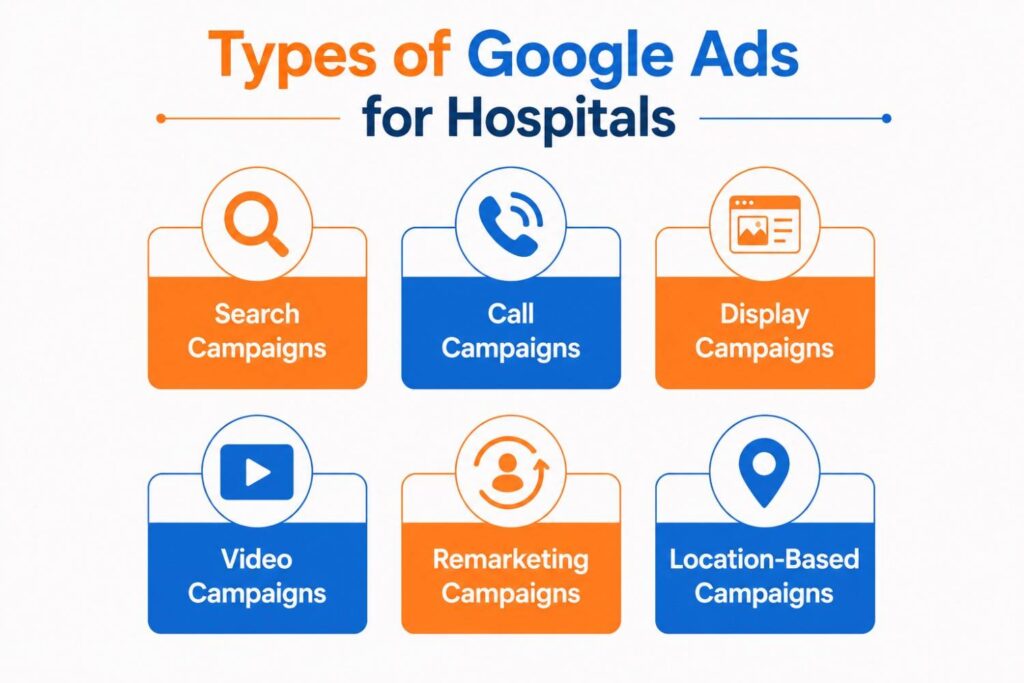
Types of Google Ads for Hospitals
Different campaign formats affect the outcome of SEO vs Google Ads for Hospitals.
Search Campaigns
Search advertisements appear when users enter selected healthcare queries. They are suitable for high-intent searches related to appointments and services.
Call Campaigns
Call-focused campaigns encourage users to contact the hospital directly. They can be useful for mobile users seeking quick assistance.
Display Campaigns
Display advertisements appear across websites and applications. They are generally more suitable for awareness than immediate appointment intent.
Video Campaigns
Video advertising can support hospital awareness, doctor introductions, educational campaigns, and service explanations.
Remarketing Campaigns
Remarketing reconnects with people who previously visited the hospital website but did not complete an enquiry.
Hospitals should handle remarketing carefully to avoid communication that appears intrusive or reveals sensitive health interests.
Location-Based Campaigns
These campaigns target people within selected areas around a hospital, clinic, diagnostic facility, or service location.
Benefits of SEO for Hospitals
The main benefits of SEO include:
- Sustainable organic visibility
- Reduced dependence on paid clicks
- Stronger website authority
- Greater patient education
- Improved local search presence
- Better visibility for multiple departments
- Long-term content value
- Increased trust through informative pages
- Support for Google Business Profile performance
- Improved website usability
When evaluating SEO vs Google Ads for Hospitals, SEO is especially valuable for organisations that want to build a lasting online foundation.
Benefits of Google Ads for Hospitals
Google Ads offers several practical benefits:
- Faster search visibility
- Accurate geographic targeting
- Flexible campaign budgets
- Measurable click and conversion data
- Promotion of new departments
- Support for time-sensitive services
- Keyword-level control
- Quick landing-page testing
- Immediate support during organic growth
- Ability to pause or adjust campaigns
In SEO vs Google Ads for Hospitals, paid campaigns are useful when speed, testing, and targeting are major priorities.
Conclusion
The comparison of SEO vs Google Ads for Hospitals shows that both channels have valuable but different roles. SEO develops organic authority, educational content, local visibility, and sustainable website traffic. Google Ads provides faster placement, precise targeting, campaign testing, and immediate support for selected departments.
Hospitals should avoid treating SEO vs Google Ads for Hospitals as a choice between two competing methods. A carefully planned combination often provides better results than depending entirely on one channel.
The right balance should reflect the hospital’s budget, goals, competition, website quality, specialties, patient journey, and timeline. Healthcare organisations in Kerala can use paid search to generate immediate visibility while SEO builds a dependable digital foundation for future growth.
To learn more about improving your website’s visibility on Google, visit Google SEO Starter Guide.

