
10 Proven Ways Healthcare Marketing Increases Appointments
Understanding how healthcare marketing increases patient appointments is important for doctors, clinics, hospitals, diagnostic centres, and other medical organisations seeking steady growth. Patients in Kerala increasingly search online, compare providers, read reviews, check services, and study appointment options before contacting a healthcare organisation.
Healthcare marketing helps a provider become visible during each stage of this decision-making process. It does not simply promote treatments. It helps patients find accurate information, understand available care, assess professional credibility, and take the next appropriate step.
When implemented responsibly, healthcare marketing connects patient needs with suitable healthcare services. This article explains how healthcare marketing increases patient appointments through search visibility, educational content, local optimisation, reputation management, website improvements, social media, and convenient communication.
What Is Healthcare Marketing?
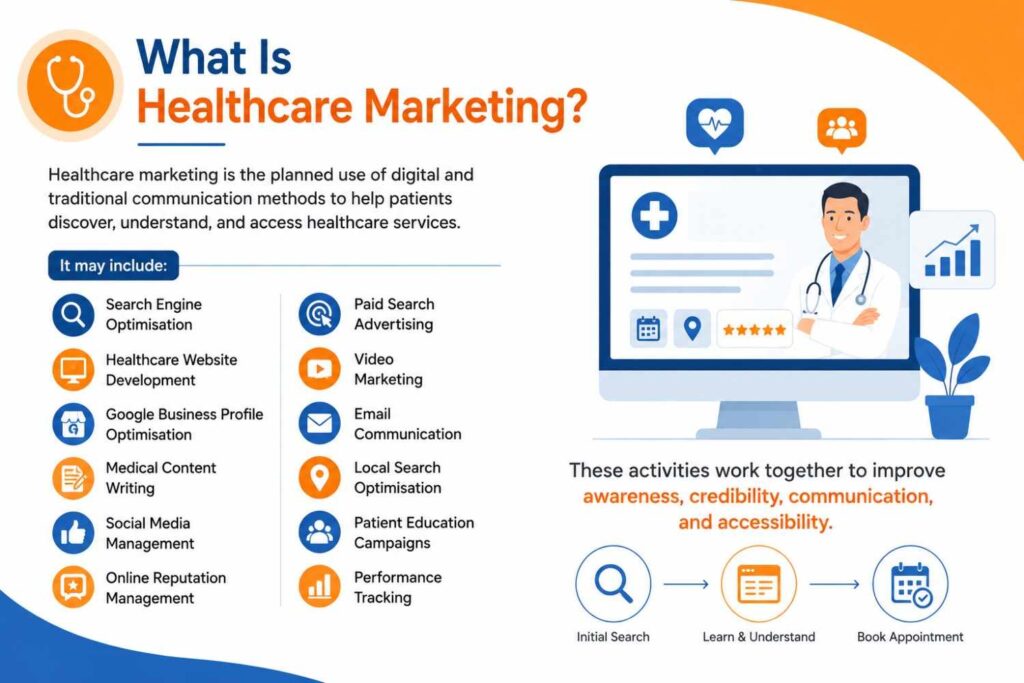
Healthcare marketing is the planned use of digital and traditional communication methods to help patients discover, understand, and access healthcare services.
It may include:
- Search engine optimisation
- Healthcare website development
- Google Business Profile optimisation
- Medical content writing
- Social media management
- Online reputation management
- Paid search advertising
- Video marketing
- Email communication
- Local search optimisation
- Patient education campaigns
- Performance tracking
These activities work together to improve awareness, credibility, communication, and accessibility.
Understanding how healthcare marketing increases patient appointments requires looking beyond website traffic. The real goal is to guide relevant patients from an initial search to an informed appointment decision.
How the Patient Appointment Journey Works
A patient rarely books an appointment immediately after seeing a single advertisement. Most people move through several stages.
Stage 1: Recognising a Need
The patient notices a symptom, needs a check-up, receives a referral, or begins researching a healthcare service.
Stage 2: Searching for Information
The patient searches for symptoms, specialists, hospitals, clinics, diagnostic services, or treatment information.
Stage 3: Comparing Available Providers
The patient may compare:
- Professional qualifications
- Available services
- Clinic location
- Consultation timings
- Online reviews
- Website quality
- Doctor profiles
- Appointment methods
- Educational content
- Contact information
Stage 4: Building Confidence
Patients may read service pages, watch videos, check photographs, review frequently asked questions, and study public feedback.
Stage 5: Booking an Appointment
The patient calls, sends a message, completes an enquiry form, or uses an online appointment system.
A successful strategy supports every stage. This complete journey explains how healthcare marketing increases patient appointments rather than simply creating online impressions.
Why Online Visibility Affects Appointment Decisions
Patients cannot consider a healthcare provider they cannot find. Online visibility ensures that relevant services appear when people actively search for help.
A provider may offer experienced care but still receive limited enquiries when:
- The website does not rank for service searches.
- The Google Business Profile is incomplete.
- Contact details are inconsistent.
- Service pages contain very little information.
- The website is difficult to use on mobile devices.
- Competitors provide clearer online information.
- Reviews are limited or unanswered.
- Appointment options are hard to locate.
Healthcare marketing addresses these gaps. This is the foundation of how healthcare marketing increases patient appointments through better accessibility.
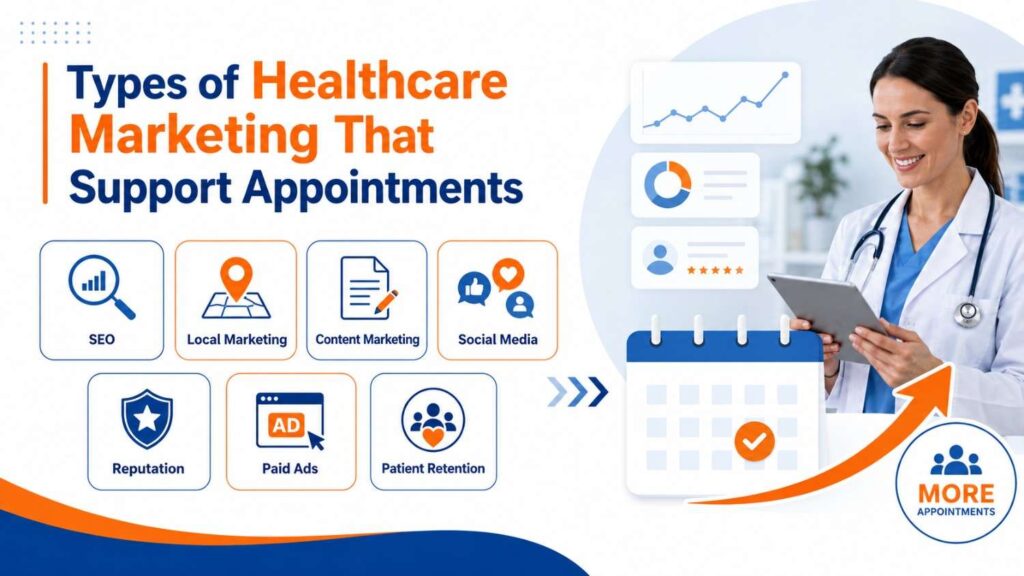
Types of Healthcare Marketing That Support Appointments
Different marketing methods contribute to appointment growth in different ways.
Search Engine Optimisation
SEO improves website visibility when potential patients search for healthcare information or services.
Local Healthcare Marketing
Local marketing improves visibility in nearby searches, map results, and location-specific service enquiries.
Medical Content Marketing
Educational blogs, treatment pages, videos, and FAQs answer patient questions and build confidence.
Social Media Marketing
Social media helps healthcare organisations share updates, explain services, and maintain regular communication.
Reputation Marketing
Review management and accurate public profiles support professional credibility.
Paid Healthcare Advertising
Paid campaigns can connect time-sensitive or high-intent searches with suitable service pages.
Patient Retention Marketing
Follow-up communication, reminders, newsletters, and educational updates may encourage continuing care when clinically appropriate.
Each method has a different role in explaining how healthcare marketing increases patient appointments.
10 Ways Healthcare Marketing Increases Patient Appointments
1. Improving Search Engine Visibility
Search engines are often the first place patients look for health information or nearby medical services.
SEO helps healthcare websites appear for searches related to:
- Symptoms
- Medical specialities
- Diagnostic services
- Treatment options
- Doctor consultations
- Preventive care
- Nearby clinics
- Hospital services
- Follow-up care
- Appointment information
SEO may include keyword research, page optimisation, technical improvements, internal linking, content creation, and local search work.
This clearly demonstrates how healthcare marketing increases patient appointments by placing useful information in front of people who are already searching.
A strong SEO page should answer the searcher’s question while providing a clear path to relevant professional care.
2. Strengthening Local Search Presence
Many healthcare searches have local intent. Patients often prefer a provider that is accessible and easy to locate.
Local optimisation may involve:
- Maintaining an accurate Google Business Profile
- Selecting relevant business categories
- Adding correct consultation hours
- Uploading professional photographs
- Listing available services
- Updating contact information
- Responding to reviews
- Publishing regular profile updates
- Maintaining map accuracy
- Using consistent business information
When a profile appears in map results with accurate information, patients can call, request directions, or visit the website directly.
Local visibility is an important part of how healthcare marketing increases patient appointments, particularly for clinics, diagnostic centres, dental practices, and speciality consultations.
3. Building Patient Trust Before the Consultation
Healthcare decisions require confidence. Patients want to know who will provide care, what services are available, and whether the organisation communicates professionally.
Trust-building information may include:
- Doctor qualifications
- Areas of clinical interest
- Professional experience
- Hospital or clinic facilities
- Consultation process
- Patient education material
- Clear contact information
- Ethical treatment explanations
- Updated service details
- Professional photographs
Healthcare marketing helps present this information consistently.
This explains how healthcare marketing increases patient appointments even before direct communication begins. A patient who already understands the provider and service may feel more comfortable making an enquiry.
4. Answering Common Patient Questions
Unanswered questions can delay appointment decisions.
Patients may want to know:
- Which specialist they should consult
- Whether a service is available
- What documents they should bring
- How to prepare for a consultation
- Whether prior reports are required
- How appointment scheduling works
- What general evaluation may involve
- When follow-up may be needed
- How to contact the clinic
- Where the facility is located
Healthcare websites, blogs, FAQs, videos, and social posts can answer general questions clearly.
Educational content is therefore a major element of how healthcare marketing increases patient appointments. It reduces confusion and helps patients make informed decisions.
5. Creating Service-Specific Website Pages
A general homepage cannot explain every service properly. Dedicated pages give patients focused information related to their needs.
A useful service page may include:
- A simple explanation of the service
- Common reasons people seek evaluation
- General assessment methods
- Available care approaches
- Preparation guidance
- Frequently asked questions
- Professional credentials
- Appointment options
- Contact details
- Related educational resources
Service pages also help search engines understand the website.
When a patient reaches a page that closely matches their search, they are more likely to continue exploring or contact the organisation. This is another practical example of how healthcare marketing increases patient appointments.
6. Using Reviews to Support Patient Confidence
Online reviews may influence how patients compare providers. They offer insight into communication, accessibility, staff behaviour, waiting experience, and general service quality.
A professional review-management strategy includes:
- Monitoring major review platforms
- Responding politely
- Thanking patients for appropriate feedback
- Avoiding discussion of private medical information
- Addressing concerns through suitable private channels
- Reporting fraudulent content when necessary
- Keeping profile details accurate
- Encouraging honest feedback without pressure
Healthcare organisations should never guarantee outcomes or use reviews to make unsupported medical claims.
Responsible reputation management demonstrates how healthcare marketing increases patient appointments by reducing uncertainty and supporting confidence.
7. Making Appointment Booking Easier
Visibility and trust may be wasted when the booking process is difficult.
Websites and profiles should make the next step clear.
Useful appointment options may include:
- Clickable phone numbers
- Short enquiry forms
- Messaging options
- Online appointment requests
- Clear consultation hours
- Map directions
- Visible contact buttons
- Confirmation messages
- Mobile-friendly forms
- Simple instructions for first-time visitors
Forms should request only the information needed for an initial enquiry. Sensitive medical details should not be collected unnecessarily through ordinary marketing forms.
A convenient booking system is one of the clearest examples of how healthcare marketing increases patient appointments.
8. Reaching Patients Through Social Media
Social media helps healthcare providers maintain visibility between active search moments.
Patients may discover educational posts about:
- Preventive care
- Common symptoms
- Health screening
- Consultation preparation
- Seasonal health concerns
- Clinic updates
- Awareness days
- Doctor introductions
- Frequently asked questions
- Available services
Social content should be educational, respectful, accurate, and easy to understand.
A patient may see a useful post, visit the profile, explore the website, and later schedule an appointment. This gradual process shows how healthcare marketing increases patient appointments through repeated, helpful communication.
9. Using Paid Advertising for High-Intent Searches
Paid advertising can place healthcare services in front of people who are actively searching.
Campaigns may target:
- Specialist consultations
- Diagnostic tests
- Screening services
- Dental appointments
- Health check-ups
- Clinic locations
- Relevant treatment information
- Time-sensitive service needs
However, advertising success depends on more than paying for clicks.
Campaigns require:
- Suitable keywords
- Accurate audience targeting
- Ethical advertising language
- Relevant landing pages
- Clear appointment options
- Mobile optimisation
- Conversion tracking
- Regular performance review
Properly managed campaigns explain how healthcare marketing increases patient appointments by connecting high-intent searches with useful service information.
10. Tracking and Improving Appointment Conversions
Marketing performance should not be judged only by followers, impressions, or website visits.
Healthcare organisations need to understand which activities produce meaningful enquiries.
Useful measurements include:
- Appointment form submissions
- Calls from website visitors
- Calls from business profiles
- Messaging enquiries
- Direction requests
- Service-page conversions
- Advertising conversion rates
- Cost per qualified enquiry
- Returning website users
- Organic search enquiries
Tracking reveals which services, pages, keywords, and campaigns contribute to appointment growth.
This data-driven improvement completes the explanation of how healthcare marketing increases patient appointments.
Symptoms of a Weak Appointment Marketing System
A healthcare organisation may have a marketing problem when the following warning signs appear:
- Website traffic grows, but enquiries remain unchanged.
- Paid advertisements receive clicks but few appointment requests.
- Patients repeatedly request basic information.
- Important services have no dedicated pages.
- Contact buttons are difficult to find.
- The website performs poorly on mobile devices.
- Business hours differ across platforms.
- Search rankings continue to decline.
- Reviews remain unanswered.
- Enquiries come from irrelevant locations.
- Appointment forms are frequently abandoned.
- Marketing reports contain no conversion data.
These symptoms help organisations evaluate whether they fully understand how healthcare marketing increases patient appointments.
Conclusion
Understanding how healthcare marketing increases patient appointments requires examining the entire patient journey. Search visibility attracts attention, educational content answers questions, professional profiles build credibility, reviews reduce uncertainty, and simple booking methods encourage action.
A healthcare organisation should not rely on one platform or campaign. SEO, local optimisation, website development, content, social media, reputation management, advertising, and analytics should work together.
By providing accurate information and improving digital accessibility, healthcare providers in Kerala can demonstrate how healthcare marketing increases patient appointments while maintaining ethical, respectful, and patient-focused communication.
To learn more about improving your website’s visibility on Google, visit Google SEO Starter Guide.

